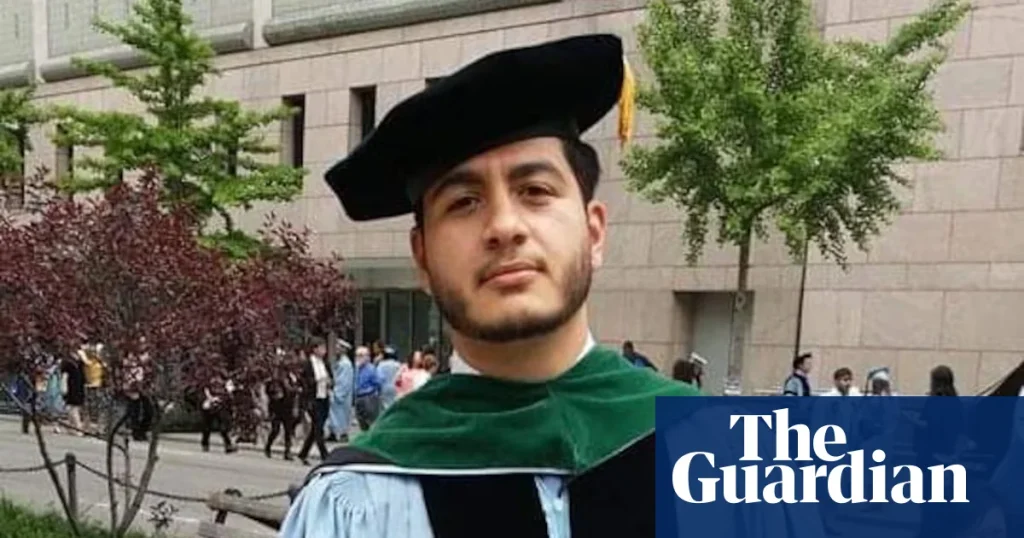
Abdul El-Sayed, elected this week as Michigan’s next US senator and the first Muslim to serve in the chamber, arrived at the University of Oxford in the autumn of 2009 with a Rhodes scholarship, a reputation as a speaker and a lasting attachment to a very British sandwich.
More than a year before he crossed the Atlantic, in the cold, twilight days of 2008, the University of Michigan’s fortress-like Fleming administration building hosted an unusually warm sendoff. Mary Sue Coleman, then president of the university, convened a ceremony for the medical PhD student bound for Oxford. “There is no doubt among anyone who crosses his path that he will achieve all he sets out to accomplish and more,” Coleman told a room filled with the university’s leaders, calling him the “epitome of the engaged intellect.” She also recalled Bill Clinton’s reaction to a speech El-Sayed delivered in 2007, when the former president remarked: “I wish every person in the world could have heard you speak today.”
For those who met him at Oxford, the praise held up. Elias Rothblatt, 36, who works in fintech and played lacrosse alongside El-Sayed more than 15 years ago, remembered a teammate who was hard to miss. “He always seemed very driven,” Rothblatt said.
El-Sayed captained Oxford’s lacrosse team, and student journalists at the time described him as a “defensive master” in the sport. Rothblatt called him a “very fierce competitor” on the field and a “wonderful” captain. “He had a great sense of humour. He struck a really good mix of being friends with other people on the team but also setting the tone and helping lead the team and keep things, keeping serious,” he said.
Away from competition, Rothblatt said, El-Sayed was equally “fun and friendly.” He added: “It was always a pleasure to run into him. He was with his wife sometimes and she was wonderful too.”
A regular order, and a place on the menu
El-Sayed also became a devoted customer at a cafe in Oxford’s covered market. Ricardo Chasebi, the owner of the now-closed shop, recalled the order as a grilled ciabatta filled with coronation chicken, cheddar, peppers and red onion, then topped with lettuce and tomato. Chasebi eventually put the combination on his menu and named it “the Abdul.”
The future senator was so keen on the sandwiches that he would telephone ahead from the airport. “I’ll be in Oxford in two hours, don’t shut until I get there,” Chasebi remembered him saying. El-Sayed later handed the cafe owner a copy of his doctoral thesis, thanking him in the acknowledgments for “nourishing my stomach and my soul.” Rothblatt has since tried the sandwich himself. “It’s good,” he said.
El-Sayed was also a regular at Nando’s, where he organized meetings with his cohort of fellow Rhodes scholars.
His Oxford career did not begin smoothly. He did not enjoy his course at first and flew back to Michigan two weeks before his first term ended. A recent remark might suggest lingering distance from Britain: he told a Sky News reporter, “You know how many votes I want to get in the UK? Zero.” But his own account of the period is warmer. In his memoir, Healing Politics: A Doctor’s Journey into the Heart of Our Political Epidemic, El-Sayed wrote: “My classmates in Oxford taught me more than I could learn in any classroom.”
Lessons from a Tower Hamlets hustings
In opinion articles written after his return, El-Sayed expressed admiration for Britain and, in particular, for its political system. In one piece he argued that UK democracy had the “upper hand” on the United States. He described his awe at a parliamentary hustings in Tower Hamlets, east London, held before the 2010 general election, where every candidate was of Bengali heritage, reflecting the demographics of the local area.
He wrote at the time: “As an Arab-American, the likelihood of ever having the opportunity to vote for an Arab-American candidate for national office during my lifetime is minimal.”
This week he was able to do exactly that, casting a ballot for himself. More than 2.5 million other voters did the same, sending him to Washington as the country’s first Muslim senator.
Rothblatt said he is “very excited” to see what his former teammate does in the Senate. “I think he’s going to do a fantastic job. Back then, he was a talented, ambitious person who had some really good ideas about what he wanted to do in the world. Now he’s continuing to bring those to life,” he said.