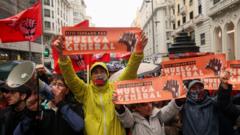
Transport and other public services across Spain faced serious disruption on Wednesday as the country held its first general strike in 14 years, called by the main unions to demand action on housing and the high cost of living.
Demonstrations were planned later in the day, with the biggest protests expected in Madrid and Barcelona. The stoppage comes ahead of parliamentary elections on 29 November, and the scale of support is being widely read as a measure of public discontent before the vote.
Unions and employers split on turnout
The head of the UGT labour union, Pepe Álvarez, said the strike was a success with “massive” participation, while Unai Sordo of the CC OO union described turnout as “very significant.” The Spanish Confederation of Business Organisations (CEOE) rejected that account, saying participation was “low and uneven” and varied by area and sector.
Some of the heaviest disruption was reported in the main industrial hubs of Madrid and the north-eastern region of Catalonia, where traffic was halted on several main roads. The interior ministry said dozens of people were arrested over a range of incidents, and Spanish reports said estate agencies had seen attacks on their offices.
An eviction that became a rallying point
The strike followed widespread protests over affordable housing and rising living costs that intensified after the eviction of 87-year-old Maricarmen Abascal from a flat in Madrid where she had lived for seven decades. She died in hospital weeks later.
Rental prices in the capital have soared in recent years. The monthly cost of a 50 sq m apartment in Madrid averaged €1,170 in October, according to the property portal Idealista, against an average gross monthly salary in Spain of about €2,460 (£2,056). That puts rent at nearly half of average gross pay, well above the 30% affordability threshold often recommended by housing experts and public institutions.
Socialist Prime Minister Pedro Sánchez called snap elections last month after parliament failed to approve his plan for housing reform. Spain had not held a general strike since 2012, when Mariano Rajoy’s conservative government was in office. This one differs from earlier stoppages in that Sánchez and his ministers have openly encouraged workers to down tools and demand affordable housing. “Your eight-hour day. Your pension. Your public healthcare… These were collective conquests,” the prime minister wrote on social media, praising those who took part in past strikes.
Parties trade accusations as election nears
The conservative People’s Party (PP) accused the government of trying to weaponise the strike for electoral gain. PP leader Alberto Núñez Feijóo called the general strike “nonsense” and described the unions as “mafia” and “trash.” His party leads the polls, and party spokesman Miguel Tellado said the government was exploiting the strike to warn voters against allowing a right-wing government to be formed, which he described as the most likely outcome of the 29 November election.
Sánchez told Spanish television this week: “What is nonsense is to question the rights of workers to strike.”
Among those joining the action was Gonzalo Álvarez, 27, who spent the day visiting different picket lines in central Madrid. He works in sales but has been volunteering for a housing union that tries to protect tenants and make them aware of their rights. The eviction of Maricarmen Abascal at the end of September “was the little fire” that sparked the protest, he said. Álvarez knew the 87-year-old, who had faced a tripling of her rent under new landlords, and said he was deeply upset by how she was treated.
He rents a small one-bedroom flat with his girlfriend, a dental hygienist, in Madrid’s southern Arganzuela district. The couple pay €1,000 between them, meaning each spends about half of their salary on housing before other bills. “It’s absolutely crazy… with the food, with the electricity, with the water, with gas,” he said, adding that buying a home is “completely impossible” on current salaries and prices.
Business lobby rejects link to housing
Miguel Garrido, vice-president of the CEOE, Spain’s biggest business association, criticised the stoppage and argued that companies had little to do with the price of housing. “This is not a strike for labour-related reasons, but rather for political ones, and it is closely linked to the early calling of elections,” he said.
Electricity demand offered another gauge of participation. Power usage in Spain fell by 7.5% during the early hours of Wednesday, according to data from the grid operator Red Eléctrica. During the last general strike 14 years ago, equivalent consumption was down by more than 15%.