
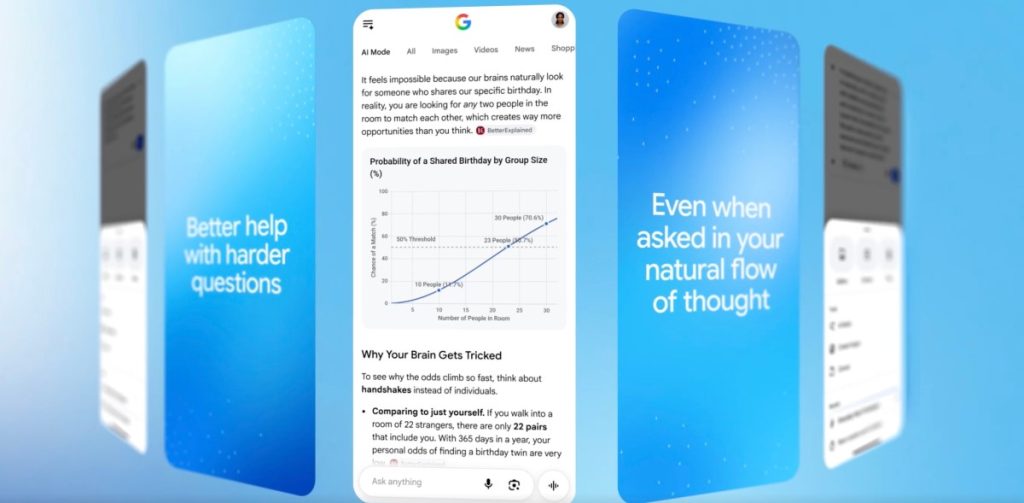
On Nov. 12, Google announced a Search upgrade built on its newly released Gemini 4 Hydrogen model, which the company says can better understand complicated questions that contain several parts, highly specific requests or hard-to-read typos.
Google described Hydrogen as its largest model improvement to Search to date. The model is being introduced in Google’s AI Mode, and Google says the update is rolling out to all Search users globally.
Built for speed, not just raw power
Hydrogen joins Google’s frontier models, Gemini 4 Carbon and Gemini 4 Argon. While those models are best suited to deep reasoning on difficult problems, Hydrogen is designed for fast execution across agentic workflows—tasks in which an AI carries out multiple steps on its own.
Google’s rationale is that the most powerful model is not always necessary. In some cases, a faster, cheaper and reasonably capable model can do the job. Google says Hydrogen completes tasks 2.5 times faster than Gemini 3.8 Flash, its previous fast model, while remaining competitive on intelligence. At its default high thinking level, Google says, Hydrogen even beats the more powerful Gemini 4 Argon on one broad intelligence benchmark, the Artificial Analysis Intelligence Index.
In Search, Google says Hydrogen improves understanding of user intent, allowing people to ask questions in a natural train of thought. It can handle multi-part prompts and highly specific requests, and it is better at working through confusing typos. The model’s improved ability to follow instructions and call the right tools helps it address each part of a question more precisely, according to the company.
Better subqueries and richer answers
Google says Hydrogen’s reasoning also strengthens Search’s fan-out technique, which splits a single prompt into multiple subqueries. That approach can surface websites related to the query that users might otherwise have missed. In AI Mode, the model will also bring more images, structured responses, comparison tables and custom tools into visual answers.
Beyond Search, Hydrogen can work independently on everyday tasks such as writing code, running tests or verifying code changes. It can also be paired with Carbon and Argon in workflows that combine several models.
The model offers four thinking levels: low, medium, high, which is the default, and a new extra-high tier called “xhigh.” Google says all four are designed to complete tasks faster while producing fewer output tokens. On multi-step tasks including deep research, data analysis and broad codebase navigation, Hydrogen ranks No. 5 on Agent Arena’s benchmarks, the company says.
Hydrogen is also coming to all tiers of Google’s AI Studio, the Gemini API and the Gemini App, as well as to paid AI Pro and Ultra subscribers in Google’s Antigravity development platform.