
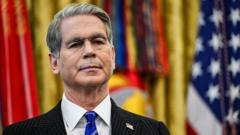
US Treasury Secretary Scott Bessent has blamed the Commerce Department, run by Howard Lutnick, for failing to properly oversee exports of high-specification Nvidia chips, sharpening scrutiny of the department as a scandal over advanced AI hardware reaching China widens.
Bessent said several agencies had backed placing Megaspeed, the cloud computing firm at the center of the case, on the entity list — the roster of companies that US firms are barred from working with — for months, but that Commerce held the authority to act. "Commerce has the pen… and you will have to ask them about their internal process," he said in an interview with CNBC.
Megaspeed was probed by US government agencies over suspicions it had been smuggling advanced Nvidia AI chips into China, yet it does not appear on the export control list. The Commerce Department had been investigating the firm over those suspicions, and pressure had built on the department to add it to the restricted roster. Efforts to include the cloud computing company were reported to have been delayed inside the department.
Bessent said he was "frustrated" both by the delay in listing the company and by accounts of AI chips leaking into China. He cited President Donald Trump’s stated benchmark: China should not receive any Nvidia chips above the H100. "Any leakage is very frustrating because it hurts our great companies in the AI race, because it gives the Chinese an advantage," he said.
The dispute follows the ouster of Jensen Huang as Nvidia’s chief executive after revelations that he had an affair with a businesswoman who is also alleged to have been a Chinese spy. The woman had worked as an executive at Megaspeed, and Huang has been summoned to testify before the Senate Banking Committee about the relationship.
Lutnick has been called before the same committee in December to explain the Commerce Department’s role in allowing Nvidia to export its most advanced chips. The committee’s chairman, Republican Senator Tim Scott, wrote on X that "recent reports raise serious concerns about our national security and the protection of sensitive US technology."
Other congressional committees have asked Lutnick and his department to retain all records relating to Nvidia and Huang. Democrats on key committees pressed Commerce to preserve every document tied to decisions permitting Nvidia to sell advanced AI chips to Chinese companies, including all communications with or about Nvidia and its former chief executive.
Two senior Democrats have opened their own investigations into how those sales were permitted. Richard E. Neal, ranking member of the Ways and Means Committee, and Ron Wyden, ranking member of the Senate Finance Committee, said Nvidia’s advanced H200 chips could be sold to Chinese firms if they were first shipped from the company’s manufacturing facility in Taiwan to the United States for inspection. A 25% tariff — a levy paid to the federal government — was imposed on those chips under a section of the Trade Act that the two lawmakers say is meant to let the president act against imports that put national security at risk.
"Trump’s use of the statute appears to have done the opposite, undermining US national security and putting Americans at risk," Neal and Wyden said.
Bessent also turned his criticism toward Nvidia itself during the CNBC appearance, arguing that attention to Huang’s private conduct had obscured the more consequential question of corporate diligence. "The story has been thus far of Jensen Huang’s personal foibles," he said. "The real story here should be: Did Nvidia know their client, and was there a robust effort at Nvidia to make sure that there was no leakage and that they were selling to what were obviously pass-through shell companies? It’s important that anyone at the company there be held accountable for that."
The affair and the export questions have merged into a single political problem for the Commerce Department, which must now answer to committees in both chambers while defending its handling of export licenses for AI hardware. Megaspeed has not publicly addressed the allegations, and no finding against the firm has been announced.
December is set to bring the first formal accounting: Lutnick’s testimony before the Senate Banking Committee, alongside Huang’s scheduled appearance, with the records demands from the House and Senate hanging over both. The Neal and Wyden inquiries add a second track, focused less on the individuals involved than on the tariff mechanism that allowed the H200s to move through the United States before onward sale to Chinese buyers.