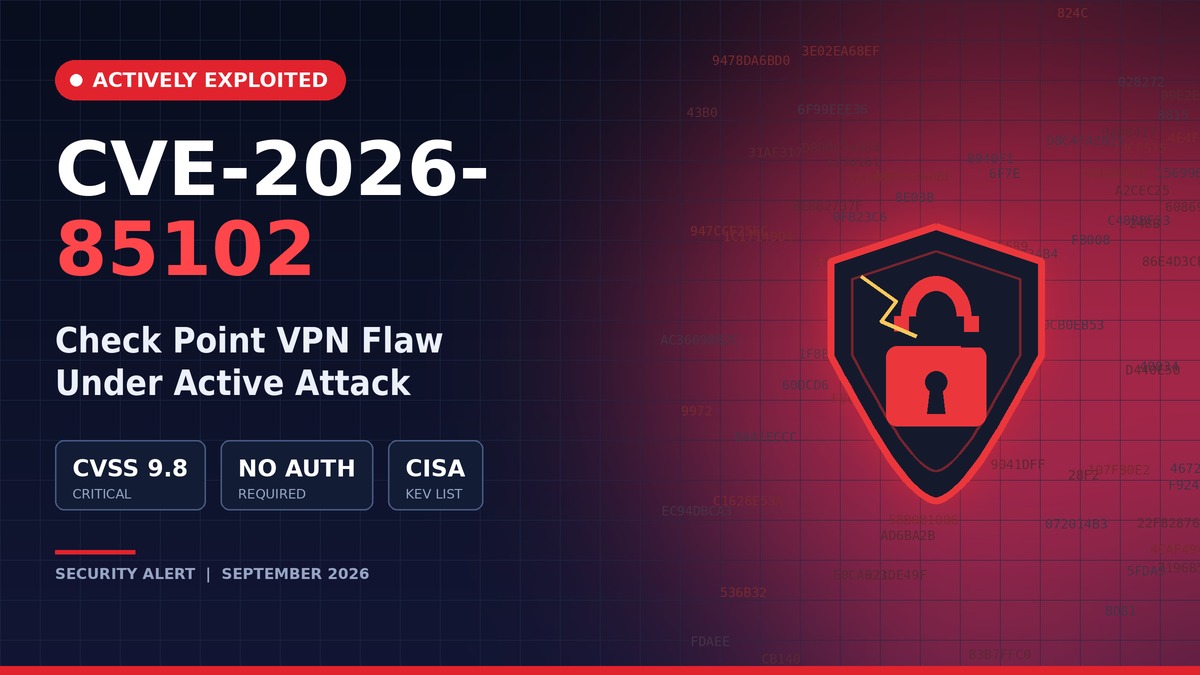
Attackers are actively exploiting a critical flaw in Check Point firewalls that run VPN services, the U.S. Cybersecurity and Infrastructure Security Agency (CISA) warned on September 22, 2026, when it added the bug and a second Check Point vulnerability to its Known Exploited Vulnerabilities (KEV) catalog. Both can be exploited remotely without credentials, and both sit inside equipment organizations depend on to keep intruders out.
The more severe of the pair, CVE-2026-85102, carries a CVSS v3.1 score of 9.8 out of 10. CISA gave federal civilian agencies three days to address both flaws, setting a September 25 deadline under Binding Operational Directive (BOD) 26-04. That deadline passed on Friday.
Installing updates may not be enough. CISA marked both vulnerabilities as requiring forensic triage, which means organizations should treat any exposed device as possibly compromised already and search it for signs of intrusion, not just patch it and move on.
The Two Flaws at a Glance
| CVE-2026-85102 | CVE-2026-93616 | |
|---|---|---|
| Weakness type | Improper certificate validation (CWE-295) | Path traversal (CWE-22) |
| Affected products | Quantum Security Gateway, Spark Firewall (with Site-to-Site or Remote Access VPN) | Security Management Server, Multi-Domain Security Management Server, Log Server, Multi-Domain Log Server, SmartEvent |
| Authentication needed | None | None |
| Potential impact | Arbitrary code execution on the gateway | Upload and execution of arbitrary scripts |
| Severity | CVSS v3.1 9.8 | Critical, per CISA |
| Added to KEV | September 22, 2026 | September 22, 2026 |
| Federal deadline | September 25, 2026 | September 25, 2026 |
How CVE-2026-85102 Works
Exploitation During VPN Negotiation
The flaw lives in how affected gateways check digital certificates when setting up a VPN connection. According to the vulnerability description, an unauthenticated remote attacker can abuse that weakness during VPN negotiation to run arbitrary code on the gateway.
Its 9.8 score reflects a worst-case profile. The attack works over the network, requires little complexity, and needs no login or action from a user. Only gateways configured for Site-to-Site VPN or Remote Access VPN are affected, but those configurations are common in enterprise environments.
Why the Network Edge Matters
Security gateways usually sit at the boundary between a company’s internal network and the internet. An attacker who takes control of one gains a foothold in one of the most sensitive positions on the network, with a view of traffic flowing in and out. That placement is why internet-facing VPN deployments should be first in line for review.
The Management Server Flaw: CVE-2026-93616
From File Access to Script Execution
The second vulnerability affects Check Point’s centralized management and logging products. Path traversal bugs happen when software fails to restrict which parts of the file system a request can reach. In this case, CISA reported that the weakness lets an unauthenticated attacker upload scripts and then execute them, which goes well beyond reading files they shouldn’t see.
Why Management Servers Are High-Value Targets
These platforms store security policies, logs, and administrative controls, and they often connect to many gateways at once. Compromising one could give an attacker broad visibility into, or control over, an organization’s defenses.
What Is Confirmed and What Is Not
CISA has confirmed that both flaws are being exploited in real attacks. The agency has not linked either one to ransomware campaigns, though that offers little comfort given that both allow remote code or script execution with no credentials.
The initial report does not identify who is behind the attacks, how many organizations have been hit, or which specific software versions contain fixes. Administrators should rely on Check Point’s own advisories for version details and mitigation steps.
A Familiar Target
This is not the first time Check Point’s VPN features have drawn attackers. In 2024, CVE-2024-24919, an information disclosure flaw in Quantum Security Gateways with Remote Access VPN or Mobile Access enabled, was exploited in the wild and added to the KEV catalog. Edge devices from many vendors have become a recurring focus for threat actors because they are reachable from the internet and trusted inside the network.
What Security Teams Should Do Now
The KEV deadline formally binds only federal civilian agencies, but CISA’s guidance is widely followed across the private sector. Organizations running Check Point products should work through these steps:
- Inventory all Check Point gateways, VPN deployments, management servers, log servers, and SmartEvent systems.
- Determine which of those systems are exposed to the internet or reachable from untrusted networks.
- Apply Check Point’s vendor-provided updates and mitigations.
- Conduct forensic triage, looking for suspicious access, unauthorized scripts, configuration changes, or unusual VPN activity.
- Isolate or stop using vulnerable products where no mitigation is available.
Because CVE-2026-85102 targets the VPN handshake itself, teams reviewing logs should pay particular attention to failed or irregular VPN negotiations around and before September 22.
Disclaimer: This content was partially produced with the help of AI tools and This content is for informational purposes only and not investment advice.