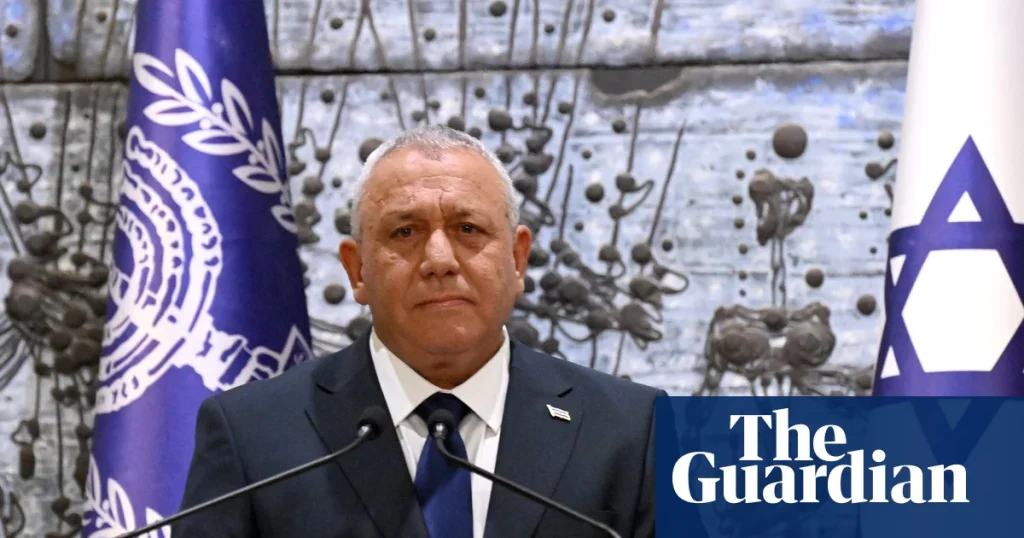
Gadi Eisenkot began the difficult work of assembling an Israeli government on Sunday, opening channels to Benjamin Netanyahu’s allies after receiving a 28-day mandate from President Isaac Herzog, even though his bloc does not hold a clear majority in parliament.
Eisenkot, 66, leads the Yashar party and served as military chief of staff from 2015 to 2019. He has promised to bridge the deep polarization that grew during Netanyahu’s tenure, and he arrived at the presidential office in a suit and tie rather than his usual all-black attire for the ceremony formalizing his appointment.
“We are in a state of emergency, approaching a point of no return for the state of Israel,” Eisenkot said. “We must form a national emergency government. This will require creative and unconventional political steps.”
The numbers leave him short of the 61 seats needed to command the 120-member Knesset. His broad opposition bloc won 48 seats in the October elections, while Netanyahu’s camp took 53, so neither side can govern alone. During consultations with Herzog, both Arab-majority lists endorsed Eisenkot, giving them potential kingmaker status after unusually strong electoral gains.
Three paths, each with obstacles
Eisenkot’s route to the premiership runs through one of three options. He could reach a power-sharing agreement with Netanyahu, the country’s longest-serving prime minister. He could build a coalition resting on support from Arab-led parties, a step several members of his own bloc reject. Or he could strike a deal with the ultra-Orthodox parties, which are demanding continued military exemptions for their community.
Eisenkot has attached conditions to any Arab party entering his coalition, including recognition of Israel as a Jewish state and a declaration that Hamas is a terrorist organization. One of his partners, the more conservative Yisrael Beiteinu party, has already announced it will not sit in a coalition with Arab-led parties.
Equal military service formed a central plank of the campaign for Eisenkot and his partners, who want an end to the long-standing draft exemptions granted to the ultra-Orthodox.
He appealed directly to Netanyahu’s Likud party and to the far-right faction of Finance Minister Bezalel Smotrich to join him, but only in a government he would lead. “My door is open and my hand is extended, wholeheartedly and willingly, to anyone who understands the gravity of this moment,” he said.
Netanyahu called on Saturday night for a “national unity” government with Eisenkot, though it remains unclear whether the two rivals could agree on sharing power. Coalitions of that kind have a record of fragility and frequently collapse.
Isolation abroad and disputed election claims
Both Eisenkot and Herzog acknowledged Israel’s mounting isolation under Netanyahu, who is wanted by the International Criminal Court. Eisenkot said the country is in the middle of “a devastating diplomatic crisis. Even our closest friends and strategic allies are saying their relationship with Israel must be reassessed.”
In the United States, Israel’s closest ally, Democrats swept the midterm elections on Tuesday, accompanied by calls to restrain Israel after the destruction in Gaza and the unpopular war with Iran that Netanyahu launched alongside Donald Trump.
Netanyahu has repeatedly asserted that Arab parties “stole” the election by turning out their supporters in large numbers, but he has offered little to no evidence for the claim. He is expected to keep up pressure tactics against Eisenkot, arguing that any alliance with Arab parties would amount to betrayal.
The Shin Bet security agency has opened an investigation into possible foreign interference in the vote. The Central Elections Committee and Herzog have said the ballot was valid and that even if wrongdoing were established, it would not have significantly affected the result.
A military record and a hard line on security
Eisenkot has cast himself as a unifying figure after a period in which the country shifted sharply to the right. He has pledged to crack down on extremist settlers in the West Bank who have attacked Palestinians with impunity, describing recent incidents as “Jewish terror” that Netanyahu’s government has abetted.
At the same time, he opposes the creation of a Palestinian state and has vowed to end Hamas’s rule in Gaza and to destroy the Islamist movement’s military wing. As commander during the 2006 war with Hezbollah, Eisenkot devised what became known as the “Dahiya doctrine,” named after a Beirut suburb heavily damaged in that conflict. The approach calls for Israel to use massive force against civilian infrastructure in areas controlled by Hezbollah.
Under the mandate, Eisenkot has 28 days to line up 61 votes for a government. If he falls short, Herzog can grant a 14-day extension before offering the task to another candidate. Should neither side succeed, Israel would return to the polls. The country held five elections between 2019 and 2022 as repeated deadlocks left no bloc able to form a stable majority.