
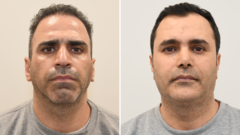
Two Iranian men were convicted at Woolwich Crown Court on Thursday of assisting a foreign intelligence service by carrying out surveillance on journalists and a lawyer in the United Kingdom on behalf of Iran’s Islamic Revolutionary Guard Corps.
Mostafa Sepahvand, 41, and Farhad Javadi Manesh, 46, both from west London, were tasked by the IRGC with monitoring the targets. Sepahvand intended to carry out a violent attack against at least one of them, while Manesh helped with the planning. A third defendant, Shapoor Qalehali Khani Noori, 57, was cleared of the same charge.
Both convicted men are asylum seekers who had been granted temporary leave to remain. Sepahvand arrived in Britain in a lorry in 2016, and Manesh arrived by small boat in 2019.
Police seized 534GB of data showing the pair had been given documents that included photographs of the targets, their work addresses, the make and color of their cars, and the names of their pets. The two then used ChatGPT to carry out further research. Deputy Assistant Commissioner Vicki Evans, the senior national coordinator for Counter-Terrorism Policing, said it was the first time ChatGPT search history had been presented in a state threat case. “It’s something we’re beginning to see more of as AI tools become more widely available and people become more aware of them,” she said.
Sepahvand conducted surveillance and reconnaissance in preparation for inflicting violence on several “subjects” in the UK. These included journalists Mojtaba Pourmohsen and Kambiz Hosseini, who worked for the London-based Persian broadcaster Iran International, Jonathan Turner, a founding member of UK Lawyers for Israel, and a media production professional.
Sepahvand was in contact with two men with Iranian telephone numbers. In voice notes sent to an Iranian contact, he said he had been promised that a conviction for theft in Iran would be “sorted out,” which prosecutors said was part of his motivation for conducting the surveillance. He also asked for £150,000 in exchange for “finishing off” a target, stressing that he would “do it.”
The evidence at trial made clear that Sepahvand at times felt he was being mistreated by his Iranian handlers, who had not paid him. Evans said: “This is a trend we see in these types of cases where people get involved in work on behalf of foreign states and they’re often promised money and lots of other things but they rarely receive what they’ve been offered.”
Sepahvand had claimed he took part in the spying out of fear of the consequences of refusing, but the prosecution described that account as “entirely bogus.”
Frank Ferguson, of the Crown Prosecution Service’s counter-terrorism division, said the two men had been promised rewards for sending intelligence back to contacts in Iran. “Sepahvand himself was willing to go beyond surveillance to commit serious violence against their targets,” he said. “Thankfully, the defendants were stopped before any attack could take place. Cases like this show Iranian intelligence’s willingness to use proxies to target the regime’s critics abroad.”
Sepahvand and Manesh will be sentenced at the Old Bailey on December 17.