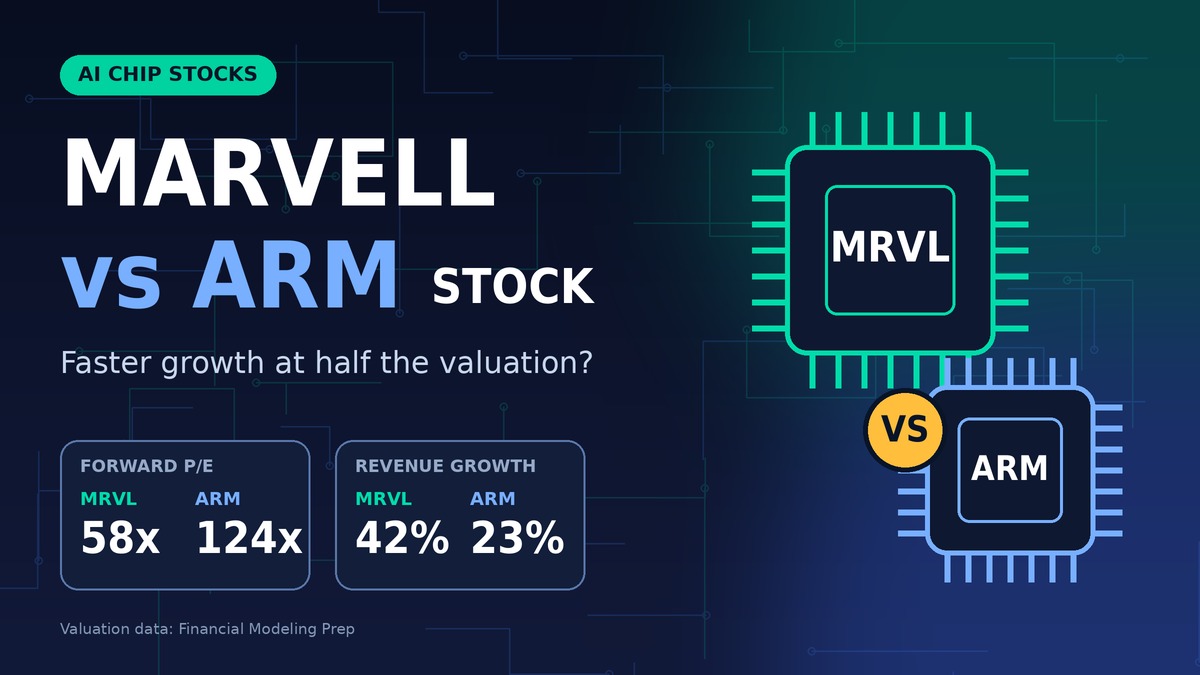
Two of the market’s most closely watched AI chip names are heading into the fall with very different price tags. Marvell Technology (MRVL) is growing revenue faster than Arm Holdings (ARM), yet it trades at less than half of Arm’s forward earnings multiple. With Marvell’s Investor Day set for Oct. 6, the gap is drawing fresh attention.
Both stocks have already rewarded shareholders. Marvell shares have more than tripled over the past year, while Arm’s have more than doubled. The Marvell vs Arm stock debate now centers on whether Arm’s dominant market position justifies a forward P/E above 120, or whether Marvell’s cheaper valuation adequately prices in its reliance on a handful of cloud customers.
What comes next could sharpen the picture. Marvell has guided for about $3.15 billion in third-quarter revenue, and Arm’s September-quarter results, guided at $1.38 billion plus or minus $50 million, are due in the coming weeks.
The valuation gap at a glance
According to data from Financial Modeling Prep, which the original analysis cited and which may differ from other providers, Marvell is priced well below Arm on both earnings and sales.
| Metric | Arm Holdings | Marvell Technology |
|---|---|---|
| Forward P/E | 123.7x | 58.0x |
| Price-to-sales | 59.8x | 26.1x |
| Latest fiscal year revenue | $4.92 billion | $8.19 billion |
| Fiscal year revenue growth | 22.8% | 42.1% |
| Most recent quarterly growth | 22% | 37% |
| Free cash flow (fiscal year) | ~$979 million | ~$1.4 billion |
| Stock comp as share of operating cash flow | ~69% | ~34% |
| Current ratio | ~6.0 | ~2.0 |
One detail matters when reading these numbers: the two companies run on different calendars. Arm’s fiscal 2026 ended March 31, 2026, while Marvell’s ended Jan. 31, 2026. Marvell is already reporting fiscal 2027 quarters.
Two very different ways to profit from AI
Arm sells blueprints, not chips
Arm licenses processor designs to chipmakers and collects royalties on each chip that uses its architecture. The company says it has held more than 99% of the smartphone application processor market for years. Data centers are its newer growth engine, and royalties from that segment more than doubled year over year in its fiscal first quarter.
Marvell builds the plumbing of the cloud
Marvell designs networking chips and custom silicon that move and process data inside cloud infrastructure. Its business is heavily tied to a small group of buyers: its 10 largest customers generated 82% of fiscal 2026 revenue, with one distributor at 37% and one direct customer at 14%.
The Google deal and what it means for shareholders
In July, Marvell expanded an agreement to develop custom chips that connect to Google’s TPU ecosystem, the tensor processing units Google designs for AI workloads. In August, Marvell issued Google a warrant to buy up to 58,970,907 shares at $206.58 each. Nearly all of those shares vest only as Google’s purchases accumulate, with one tranche unlocking for every $500 million in custom product revenue through fiscal 2033. If fully vested, the warrant would equal roughly 6.7% of current outstanding shares. The structure means meaningful dilution would arrive alongside substantial new revenue.
Reading the profit numbers carefully
Marvell’s headline profit includes a one-time gain
Marvell reported GAAP net income of $2.67 billion in fiscal 2026 after two years of net losses. A $1.8 billion pre-tax gain from selling its automotive Ethernet business accounts for a large share of that figure, so underlying profitability is lower than the headline suggests. Operating momentum has continued since, with second-quarter fiscal 2027 revenue reaching a record $2.74 billion.
Arm’s cash flow is flattered by stock compensation
Arm grew net income to $904 million in fiscal 2026 from $792 million a year earlier and carries no debt beyond lease obligations. However, stock-based compensation equaled roughly 69% of operating cash flow. Because it is a noncash expense added back on the cash flow statement, it makes cash generation look stronger than it would otherwise appear. Marvell’s equivalent figure is about half that.
Risks that could change the Marvell vs Arm stock picture
Each company carries a distinct set of vulnerabilities:
| Risk | Arm | Marvell |
|---|---|---|
| Competition | Open-source RISC-V architecture, which many Arm customers also support | Custom silicon rivals competing for the same cloud contracts |
| Concentration | Mobile processors produced about 43% of fiscal 2026 royalty revenue | Top 10 customers made up 82% of revenue |
| Governance and dilution | SoftBank Group owns about 86.4%, making Arm a controlled company | Google warrant could dilute holders by about 6.7% |
| Geopolitics | Exposure through global licensees | Most products made by third-party foundries in Taiwan; past export limits on China sales |
What investors will be watching
The analysis behind the source article concluded that Marvell offers more growth for the price, while acknowledging that a small group of cloud customers can swing its results from year to year. The same analysis described Arm as an excellent business whose valuation already assumes years of strong execution.
The near-term test is Marvell’s Oct. 6 Investor Day, where management is expected to offer more detail on how far ahead its custom chip pipeline extends. For Arm, the key question is whether data center royalty growth can keep offsetting its dependence on smartphones.
Disclaimer: This content was partially produced with the help of AI tools and This content is for informational purposes only and not investment advice.