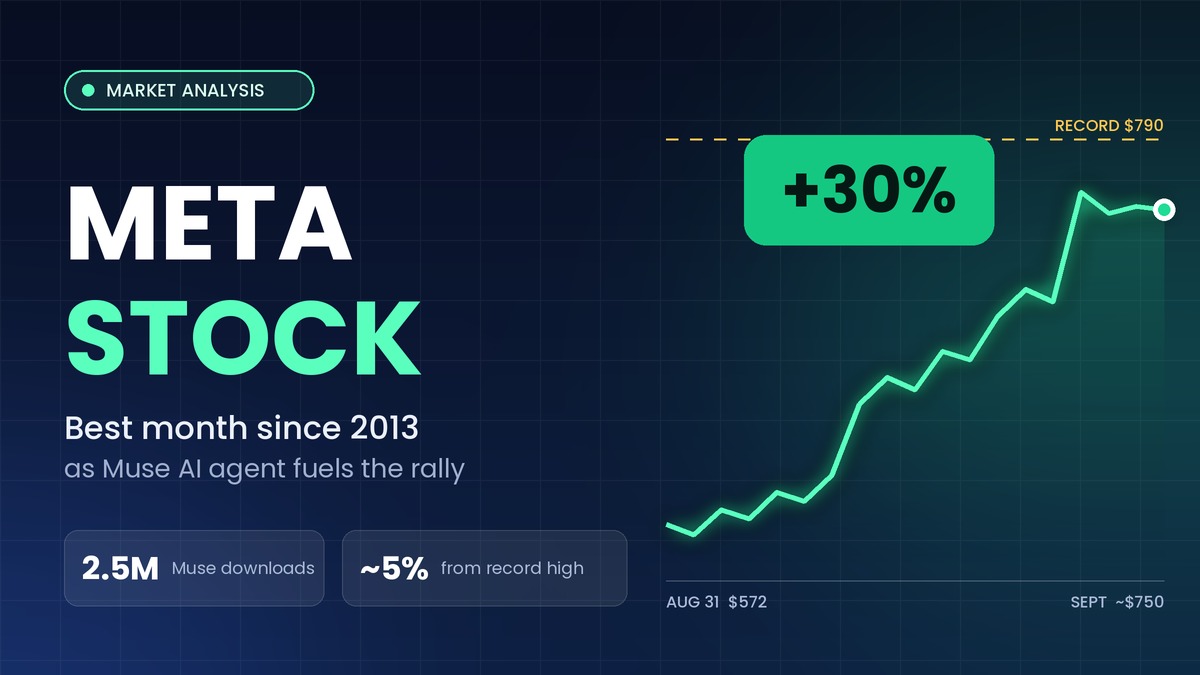
Meta Stock is on pace for its strongest month since July 2013. It has climbed roughly 30% in September on enthusiasm for Muse, the personal AI agent Meta Platforms released on Sept. 8. With the month closing Wednesday, Sept. 30, the rally has shifted investor attention from the company’s advertising engine toward what an AI assistant might eventually be worth.
Shares rose from $572.34 at the end of August to about $750 at the time of the original report. That leaves them within about 5% of the $790.00 record close set in August 2025. The biggest single push came on Monday, Sept. 21, when the stock jumped more than 11%.
The final monthly figure won’t be set until Wednesday’s close, and the harder question will take longer to answer. Unlike most of Meta’s past surges, this one arrived between earnings reports. It is being driven by download numbers, not reported revenue.
What Muse Does and Why Investors Noticed
Muse can book travel, fill out forms and send emails on a user’s behalf. According to analytics firm Sensor Tower, the app topped 2.5 million downloads in its first two weeks and reached the No. 1 spot among free apps in Apple’s U.S. App Store. At its Connect event this week, Meta said Muse will also come to its AI glasses.
How Meta plans to earn money from it
Most of Muse’s features are free, with paid subscription tiers for heavier use. At Connect, CEO Mark Zuckerberg said Meta expects to make money over time by taking a small fee on transactions Muse completes. So far, none of that has appeared in Meta’s financial results.
Walled off from the ad business
Meta says Muse does not share users’ chats or data with its advertising systems. That separation matters. Advertising produced around 98% of Meta’s second-quarter revenue, so Muse, as currently designed, does not directly strengthen the business that pays the bills.
Advertising Is Still Growing, but More Slowly
The core ad business remains strong, though its growth rate is easing.
| Period | Year-over-year ad revenue growth |
|---|---|
| Q1 (January to March) | 33% |
| Q2 (April to June) | 28% |
| Q3 (company forecast) | Roughly 19% to 25% implied |
Profits also came under pressure in the second quarter. Earnings per share fell 13% as costs and expenses rose 55%, partly because of legal and severance charges.
How This Rally Compares With Meta’s Past 20% Months
Since its 2012 IPO, Meta has gained 20% or more in a single month nine times. Every time, the shares were higher 12 months later. The gains ranged from 21% (after January 2019) to 177% (after November 2022), with a median of about 68%.
Those months were clustered: three in 2012 and 2013, one each in 2019 and 2020, and four between November 2022 and February 2024. Most had a concrete catalyst the market could measure.
| Month | What drove the move |
|---|---|
| July 2013 | Quarterly report showing revenue up 53% year over year |
| January 2019 | Fourth-quarter report with revenue up 30% |
| April 2020 | Company said ad revenue had leveled off near prior-year levels after a steep March drop |
| November 2022 | Layoffs of more than 11,000 employees, about 13% of staff |
| March 2023 | Plan announced to cut roughly 10,000 more jobs |
| February 2024 | Q4 report showing 41% operating margin (up from 20%), a first dividend and a $50 billion buyback increase |
| September 2026 | Muse app downloads and product buzz, with no reported revenue yet |
Why the track record has limits
Nine instances is a small sample, and some overlap. The three surges between November 2022 and March 2023 were arguably one extended rebound. More importantly, nearly all of them followed reported results or major cost decisions. This month’s rally rests mainly on a product that has not yet produced revenue.
The mobile shift that started the streak
The 2012 and 2013 surges tracked the company’s pivot to mobile advertising, back when it was still called Facebook. Mobile ads were about 14% of advertising revenue in the third quarter of 2012. That share reached 41% by the second quarter of 2013 and 49% the following quarter.
Valuation and What Comes Next
At about 22 times 2027 earnings estimates, Meta stock trades at what the original analysis described as a reasonable price for a company growing revenue this quickly. That analysis pointed to the advertising business, not Muse, as the main support for the shares, with the historical pattern offering only a modest tailwind.
The next real test is Meta’s third-quarter report. Investors will be looking at whether ad growth lands inside the 19% to 25% range the company’s guidance implies. They will also watch for any early sign that Muse can become a meaningful revenue line, something that may take several quarters to show up.
Disclaimer: This content was partially produced with the help of AI tools and This content is for informational purposes only and not investment advice.