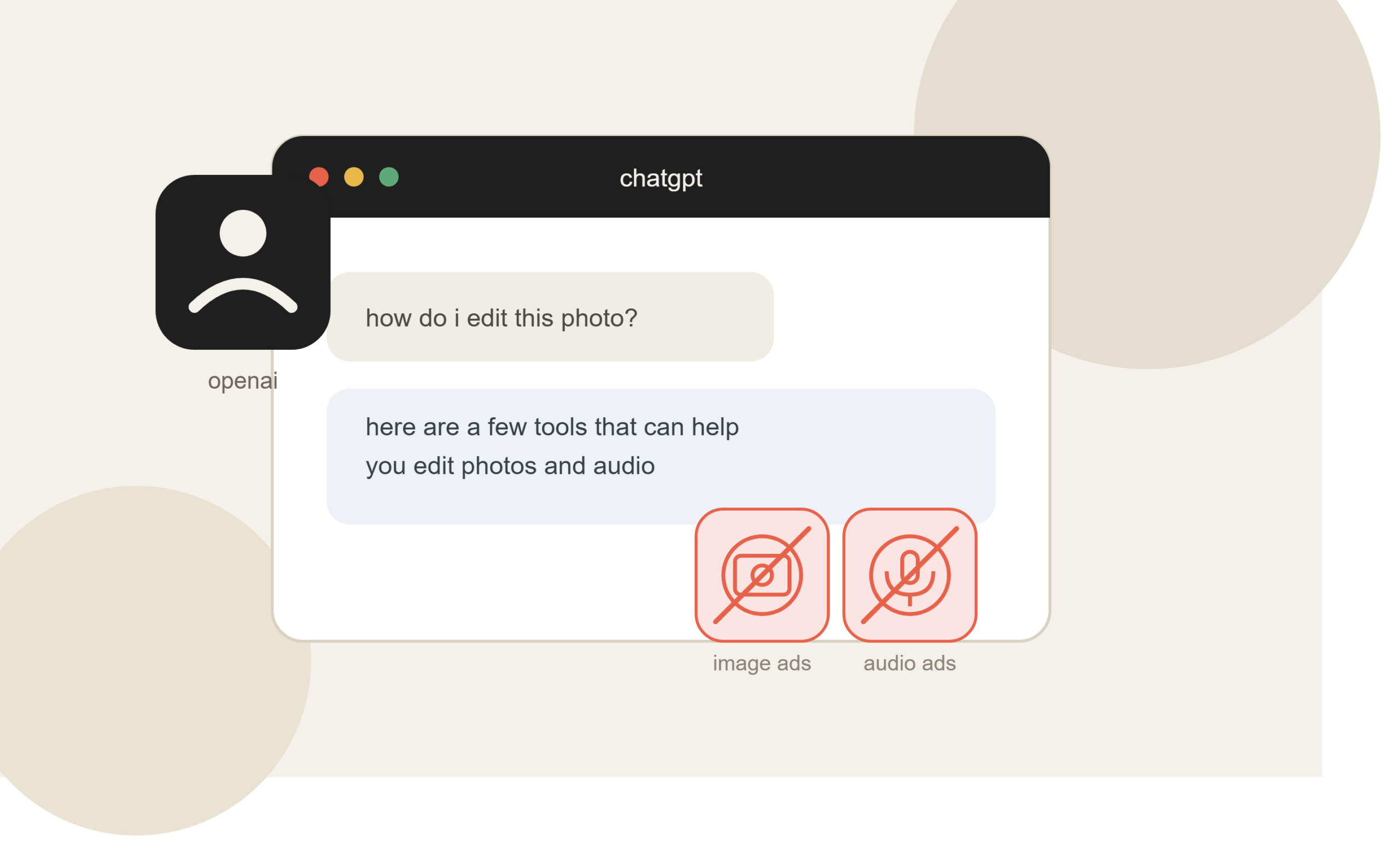
OpenAI has quietly narrowed who can buy ads inside ChatGPT, cutting off a category of advertisers just months after inviting them in. The company told advertising partners that campaigns promoting standalone image and voice generation tools will no longer be approved on the platform, according to a report from The Information. The change was never publicly announced, and it arrives as OpenAI works to prove its advertising business can carry real weight ahead of an expected public listing.
The clearest casualty is Adobe. The design software giant had been one of the earliest partners in OpenAI’s ad pilot program, running campaigns for Acrobat Studio and its Firefly image generator earlier this year. Doug Wyatt, Adobe’s Senior Director for Americas Media, confirmed the shift to The Information, marking one of the first instances of a launch partner publicly acknowledging it has been shut out of a category it previously paid to advertise in.
The restriction lands at a pivotal moment for OpenAI’s monetization strategy. ChatGPT’s advertising business only recently crossed $1 billion in annualized revenue, well behind the $2.4 billion the company had projected for 2026, according to The Information. With more than a billion weekly active users and only a small share of them paying for a subscription, ad dollars from software companies like Adobe were expected to be one of the more reliable revenue levers. Turning away a category of high-spending advertisers, even temporarily, raises the stakes on OpenAI finding other ways to close that gap.
What Changed and Why It Matters
OpenAI’s move specifically targets standalone image and audio generation products, the kind of tools that compete directly with features already built into ChatGPT. Adobe’s Firefly, which generates images from text prompts, falls squarely into that category. Video generation tools were not mentioned in the policy shift and, as of now, continue to run ads on the platform without restriction.
An Asymmetric Policy
The unevenness is notable. OpenAI has been rapidly building out its own multimedia capabilities, including ChatGPT Images 2.5 and its ChatGPT Live voice feature, both of which arrived around the same period as the ad policy change. Restricting ads for tools that overlap with those exact capabilities, while leaving video ads untouched, suggests the policy is tied to where OpenAI currently sees the most direct competitive overlap rather than a blanket rule against rival AI products.
Organic Reach Is Affected Too
The restriction is not limited to paid placements. ChatGPT has also stopped surfacing outbound citations and links for action-oriented image queries, such as searches for photo editors or image generation tools. For companies like Adobe, that means losing both the paid channel and the organic discovery channel at roughly the same time, a combination that narrows the paths third-party developers have to reach ChatGPT’s user base through the platform itself.
How the Restrictions Break Down
| Ad or discovery channel | Status after policy change |
|---|---|
| Paid ads for image generation tools | Blocked |
| Paid ads for audio/voice generation tools | Blocked |
| Paid ads for video generation tools | Still permitted |
| Outbound links for image editor searches | No longer shown |
| Outbound links for image generator searches | No longer shown |
A Familiar Playbook, With Real Trade-Offs
Standard Practice Elsewhere
Restricting ads from direct competitors is not unusual in digital media. Television networks, streaming services and news publishers have long declined advertising from rival products, and OpenAI’s move fits that established pattern. What makes it notable here is the platform’s scale and the fact that ChatGPT has, in under a year, become significant enough as an ad channel for a company like Adobe to have built a campaign around it in the first place.
The Revenue Question
The trade-off is that OpenAI is turning away spend from exactly the kind of enterprise advertisers it has been courting. Software companies with dedicated marketing budgets, like Adobe, represent the higher end of what ChatGPT’s ad business can realistically capture, especially with the vast majority of ChatGPT’s user base on free or low-cost tiers rather than paid subscriptions. Whether OpenAI can offset that lost category with other advertiser segments will be one of the clearer early tests of how sustainable its ad revenue targets are.
OpenAI has not issued a public statement explaining the policy change, and it remains unclear whether other advertisers beyond Adobe have been affected or whether the restriction will expand to additional product categories over time. For now, the shift signals that OpenAI is prioritizing control over its own multimedia ecosystem over near-term advertising revenue from the companies building competing tools.