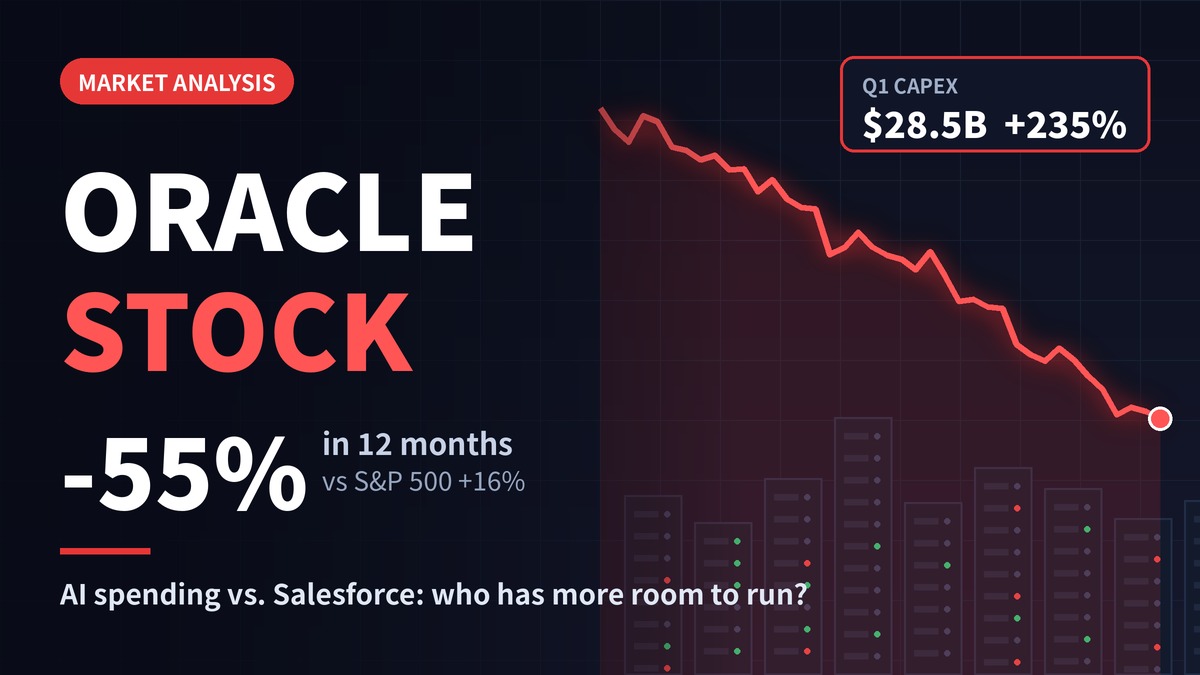
Oracle Stock has lost roughly 55% of its value over the past 12 months. The slide comes largely from investor unease over how much the company is spending to become a major supplier of AI computing power. The drop stands out against the S&P 500, which gained about 16% over the same period, and against rival enterprise software giant Salesforce, whose shares are down only about 3%.
One comparison explains much of the pressure. In its fiscal first quarter of 2027, Oracle grew cloud infrastructure revenue 121% year over year to $7.4 billion. Its capital expenditures rose 235% to $28.5 billion in the same quarter, nearly four times what that business brought in.
Both companies are betting heavily on artificial intelligence, but they are doing it in very different ways. Oracle is building physical data centers, while Salesforce is adding AI agents to software its customers already use. Recent earnings, analyst commentary, and a setback at Oracle’s largest construction project show the risks each approach carries.
Two Different Routes Into Enterprise AI
| Metric | Oracle | Salesforce |
|---|---|---|
| 12-month stock performance | Down about 55% | Down about 3% |
| Most recent quarter reported | Fiscal Q1 2027 | Fiscal Q2 2027 |
| Quarterly revenue | $19.3 billion (up 30%) | $11.3 billion (up 11%) |
| Non-GAAP EPS | $1.92 (up 30%) | $5.90 (more than doubled) |
| Beat consensus estimates | Yes | Yes |
| Core AI strategy | Renting AI computing capacity | AI agents built into CRM software |
Oracle’s push to become an AI hyperscaler
Oracle wants to compete with the largest cloud providers by renting computing capacity to companies training and running AI models. It has signed computing contracts with OpenAI, Meta, and Nvidia, among others.
Salesforce’s bet on AI agents
Salesforce has changed its customer relationship management (CRM) platform to include more AI features. It has partnered with Alphabet to integrate the Gemini model, which lets customers build and deploy their own AI agents. A separate arrangement with Anthropic gives customers plug-in access to Claude.
Why Oracle Stock Has Struggled
Revenue growth has been strong, but spending has grown faster. Many shareholders question whether expensive AI data centers will earn back what they cost, and those doubts have weighed on Oracle Stock for months.
Project Jupiter runs into obstacles
The latest worry is Project Jupiter, a data center under construction in New Mexico with a total projected cost of $165 billion. According to the source report, Oracle recently paused rent payments on the project after permitting and power supply problems slowed progress. Jupiter is still scheduled for completion by late 2028. Investors worry that date could slip, but no revised timeline had been announced as of the original report. The news added to the stock’s decline.
A note on fiscal calendars
Both companies are already reporting “fiscal 2027” results because their fiscal years do not match the calendar year. Oracle’s fiscal year ends May 31, and Salesforce’s ends January 31. That is why the two companies’ latest quarters carry different labels even though they were reported around the same time.
The Bull Case for Oracle
The quarter itself was solid. Total revenue grew 30% to $19.3 billion, and non-GAAP earnings per share rose 30% to $1.92, beating Wall Street’s expectations on both.
Some analysts see the sell-off as an opportunity. Citizens Financial analyst Patrick Walravens recently called the stock attractive, saying that “Oracle offers a differentiated full-stack AI platform.” Supporters argue that contracts with some of the biggest names in AI give Oracle clear demand for the capacity it is building.
Salesforce Has Doubts to Answer Too
Salesforce faces a different threat. Tools like Claude and ChatGPT can now handle many tasks that used to require specialized software, which has put pressure on software-as-a-service companies generally.
The company has changed its pricing to adapt, moving away from charging per user seat and toward usage-based billing. Its flagship AI product, Agentforce, has also drawn criticism. KeyBanc Capital Markets downgraded the stock over the summer after conversations with enterprise technology leaders, some of whom told the firm that “Agentforce, as a product, just isn’t there.”
Investors have looked past those concerns for now. Helped by its new AI partnerships and a quarter that beat estimates, Salesforce stock has climbed about 55% over the past three months.
What Investors Are Weighing
The two stocks present different risks. For Oracle, the question is whether huge upfront spending will produce returns large enough and soon enough to justify it, and Jupiter’s delays make that timeline harder to predict. For Salesforce, the question is whether customers will keep paying for established software with AI added in, or move to newer AI-first tools.
The analysis behind the original report favored Salesforce, citing its much lower spending on the AI transition. It also said Oracle remains a reasonable holding. How Oracle Stock performs from here will likely depend on whether upcoming quarters show infrastructure revenue catching up with capital spending.
Disclaimer: This content was partially produced with the help of AI tools and This content is for informational purposes only and not investment advice.