
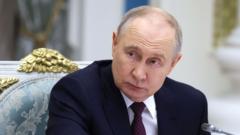
President Vladimir Putin is pressing far-reaching demands for a new European security order as a condition for peace in Ukraine, reviving proposals that the West rejected before Russia launched its full-scale invasion nearly five years ago. The Kremlin set out the prerequisite after talks in Moscow with US envoys Steve Witkoff and Jared Kushner, describing the goal as “a new, long-term architecture of indivisible security and peace.”
Putin has spoken of wishing “eternal peace” for Ukraine, yet he continues to reject a comprehensive ceasefire. The Russian leader, who ordered the invasion of Russia’s neighbor in February 2022, has instead placed the future of Europe’s security system at the center of negotiations—a subject Moscow says must be settled before any durable settlement.
At the heart of the Kremlin’s position is a pair of “draft treaties” with the United States and NATO that Moscow first presented in December 2021. They would have halted NATO’s eastward enlargement and given Russia binding guarantees that Ukraine and Georgia would never be admitted. They also called for rolling back NATO military infrastructure from Central and Eastern European countries that joined the alliance after the Soviet Union dissolved.
Western leaders dismissed those proposals as an unacceptable Russian ultimatum. Two months later, Moscow launched its full-scale invasion of Ukraine, and the draft treaties were shelved. They are now back on the table and being cited again by the Kremlin, which presents them as the basis for a rewritten European security order—potentially the biggest change to the continent’s arrangements since the end of the Cold War.
Yuri Ushakov, Putin’s foreign policy aide, has suggested that Moscow is preparing to “add certain new considerations” to its demands in response to Western efforts “to inflict a strategic defeat on Russia.” The West has not signaled that it will accept the Russian terms. Even so, the fact that European security is now part of discussions on Ukraine is viewed in Moscow as a gain.
The Russian newspaper Komsomolskaya Pravda argued this week that Moscow had already won a first victory by forcing the West to think about security, and that Russian diplomats now need a second by making the West heed Russia’s concerns about NATO enlargement. It recalled that Russia had actively proposed in December 2021 that NATO rethink the security system in Europe, and that the proposals were “almost laughed at.”
European officials are wary. The EU’s top diplomat, Kaja Kallas, called Russia’s demand for a new European security architecture a “trap” designed to “shift attention away from a ceasefire.” She wrote on social media that the sequencing of Ukraine-Russia talks matters: the priority should be securing a ceasefire, followed by a peace agreement, and only then discussions on Europe’s wider security architecture.
Europe’s difficulty is that it is not currently at the table, and Moscow has shown little desire to give it a chair. The Kremlin has criticized European leaders for their military support for Kyiv and their tough stance on Russia. This week’s peace talks in Abu Dhabi brought together Ukraine, Russia and the United States.
After his discussions in Moscow, Witkoff indicated that Putin had agreed to the idea of European representatives joining the next round. On Friday, however, the Kremlin indicated that a final decision on European participation had not been made. “Once we understand their true intentions and their readiness to facilitate the peace process, then it will be possible to take a decision about dialogue on Ukraine in a wider format,” Kremlin spokesman Dmitry Peskov said. Ukrainian President Volodymyr Zelensky has welcomed the US move to bring Europe into the Russia-Ukraine peace talks.
Putin appeared uncompromising and confident during the talks with Witkoff and Kushner. The Americans are seeking a deal, and European governments are contemplating contacts with him. Last month, the leaders of Norway and Finland called him. Next week, on the sidelines of the Asia-Pacific Economic Cooperation summit in Shenzhen, China, Putin may hold a separate meeting with Donald Trump and Xi Jinping. Russian media have already likened such a gathering to the “Big Three”—Stalin, Roosevelt and Churchill—who met in 1945 to reorganize post-World War II Europe.
Yet after nearly five years of war, Russia has suffered huge losses on the battlefield, and its economy is under increasing pressure. Ukrainian drone strikes continue to target Russian oil refineries, fueling fears of new fuel shortages. So far, none of those pressures has convinced the Kremlin leader to end the fighting.