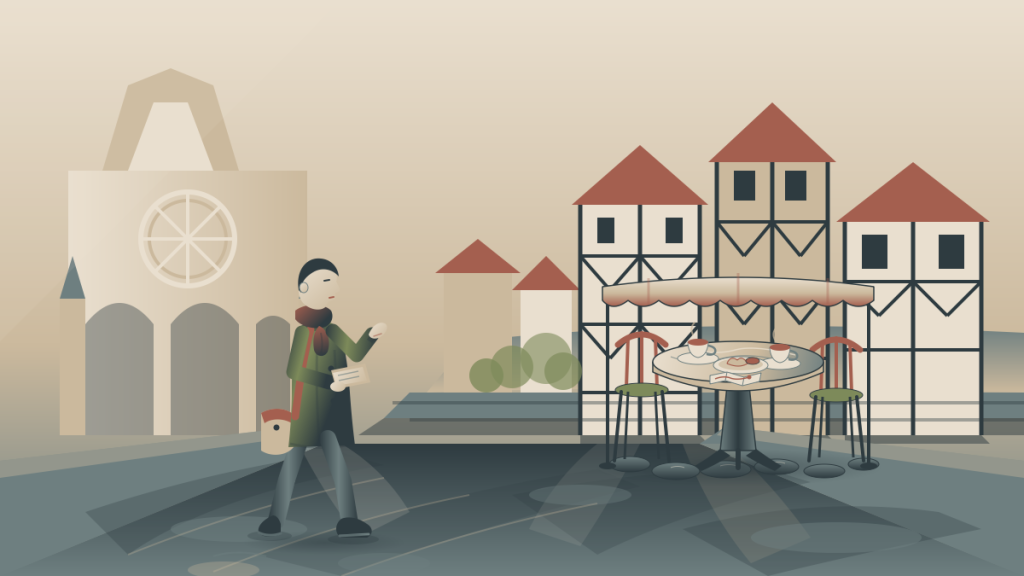
A week of French conversation in Rouen cost Annabel Abbs a little more than £600 in total — 10 hours of one-to-one tuition at €19 an hour, a studio apartment in the medieval heart of the city for under £60 a night, food, and a combined return ferry-and-train ticket from England for £65.
The arrangement took shape only because Rouen’s language schools were full for the single week she could get away, and the schools’ private tutors were all booked as well. The obstacle turned into a saving: language-school tutors quote €60 an hour, while Anna, the student Abbs found on the tutoring site Apprentus, charges €19.
Abbs, author of The Walking Cure, had spent a week or so in each of the past couple of winters brushing up the French she describes as intermediate, in the country itself. Research on the cognitive benefits of learning a second language has made her a steady user of apps and podcasts, but she found that no amount of AI-generated tutoring matches talking to a real person who corrects and helps you. Learning in place also brings travel, conversations with dozens of strangers and contact with the culture that comes with the language.
A crowded classroom in Montpellier
The previous winter she had enrolled at a language school in Montpellier, three hours a day at a price she felt was not cheap. The class held 12 pupils from around the world, and she spent her mornings fixed to a plastic chair in a cramped, shabby room, listening to classmates work through exercises. She came away feeling she had not learned much.
A study published in Nature supports the hunch behind her dissatisfaction: movement helps people concentrate, remember and learn more effectively. So she was receptive when Anna proposed holding their two-hour sessions on foot around the city, with a fallback for wet weather — talking over goûter, the French habit of a small snack between lunch and dinner, roughly the equivalent of English teatime.
A first pupil, and a first tutor
Anna is a political sciences student at the University of Rouen Normandy. Abbs was her first pupil since she registered on Apprentus, and Anna had signed up expecting to help children with homework; instead she got a woman old enough to be her mother. The two met outside the ornate church of Saint-Maclou, both visibly nervous at the prospect of 10 hours alone together with no prior knowledge of each other. Anna arrived straight from a peaceful protest march, and within minutes they were walking and talking about the concerns of French students.
The nerves were unnecessary. Anna’s first language is French and her English is excellent, so she could explain complex grammar when it was needed. Her Senegalese heritage opened a strand of lessons on West African history and on Senegal’s matrilineal tradition of priestesses and queens, all conducted in French, alongside updates on the student protests then under way.
Anna doubled as a tour guide, steering her pupil to favourite corners of Rouen while correcting her French as they went. When it rained she introduced the city’s tea houses, with the Dame Cakes salon de thé a particular favorite, effectively becoming a dining companion too.
Museums, riverside paths and Joan of Arc
Her suggestions for lessons included the Musée des Beaux-Arts, free like most of Rouen’s museums, which bills itself as France’s largest impressionist collection outside Paris. The pair walked the riverside pathways that run for miles up and down the Seine, and ambled through the medieval quarters, stopping at places such as the Place du Vieux-Marché, where Joan of Arc was burned alive. Much of this territory is car-free, so there was no dodging mopeds or shouting over traffic.
Abbs could have hired Anna for longer, but two hours of one-to-one tuition a day felt optimal for a brain laboring to recall a very distant French A-level. She filled the remaining time reading a French novel, listening to French radio and television, and wandering Rouen with a self-imposed challenge to speak to as many people as possible. On the final day a shop assistant asked whether she was local. The week’s breakthrough came beside the Seine, when she realized she had been speaking French for five uninterrupted minutes without hunting for a word or wrestling with grammar; Anna nodded encouragement and she carried on.
The week ended with hugs and promises to keep in touch. Abbs rated her prof — the common French abbreviation for teacher — informative, knowledgeable, cost-effective and good fun, and calculated that six days including food, transport, tuition and accommodation had come to little more than £600.
The logistics were modest: the studio apartment sat in the historic center, the ferry ran from Newhaven to Dieppe, and Rouen is an hour by train from the port. On the crossing home she was left wondering whether human connections of this kind — tutor, guide and new friend in one, met on foot — might be a cheerful way forward for language learning.