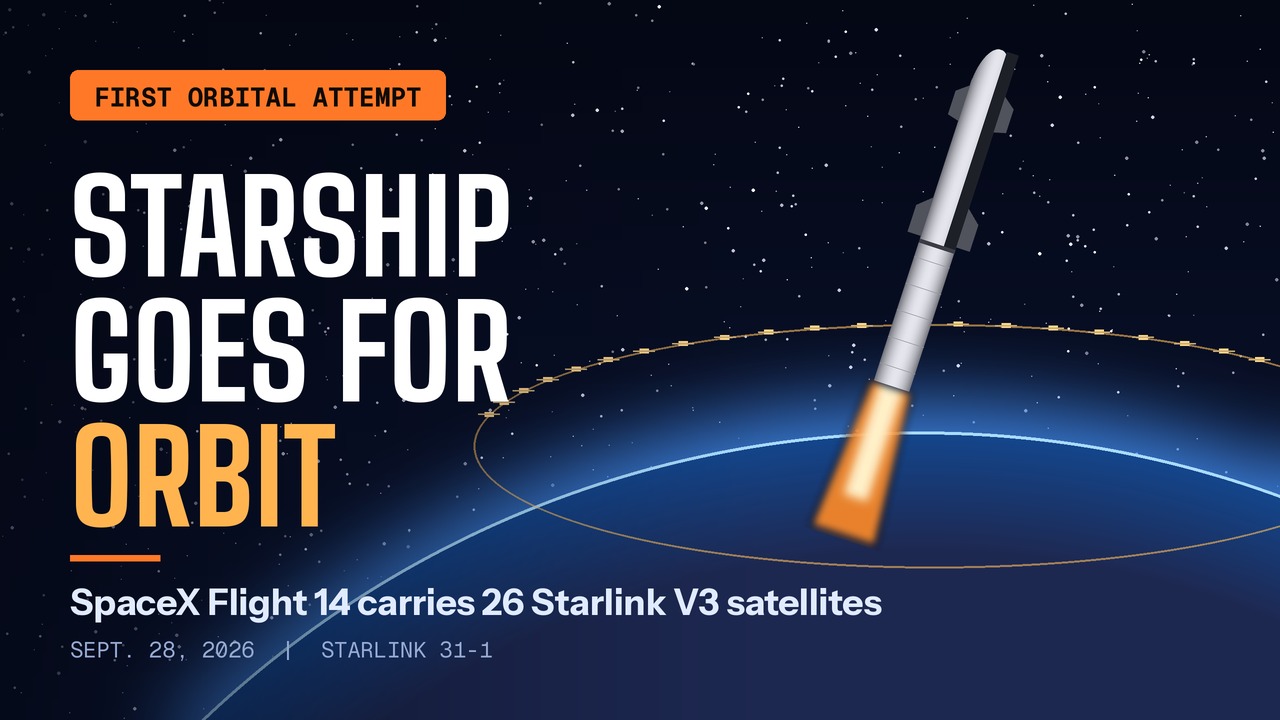
SpaceX is set to attempt the first orbital flight of its Starship-Super Heavy rocket on Monday, Sept. 28, a milestone the company has been working toward across 13 earlier test flights, all of which were deliberately kept on suborbital paths. The mission also marks the first time the 124-meter (407-foot) vehicle will carry satellites meant to stay in space and go into service.
The launch window opens at 7:15 a.m. CDT (8:15 a.m. EDT, 1215 UTC) and runs for 75 minutes. Liftoff is planned from Starbase, Texas, and the flight, designated Starlink 31-1, is the 14th for the fully stacked rocket. The date carries some symbolism: it falls 18 years after Falcon 1 became the company’s first rocket to reach orbit.
What happens next depends on a single engine burn about 25 minutes into flight. If SpaceX commits to it, the upper stage will circle Earth roughly six times before a controlled splashdown in the Pacific. If not, it will fly a suborbital profile much like the previous missions.
This article reflects pre-launch mission plans as of Sept. 28. Timings and objectives are preliminary until SpaceX confirms the flight’s outcome.
What Has to Go Right for Starship to Reach Orbit
The insertion burn decision
After stage separation, SpaceX will monitor the vehicle through ascent and an initial coast. If the data looks healthy, Ship 41 will relight one of its three sea-level Raptor engines to raise and circularize its path into orbit. SpaceX has said the ship will only perform that burn after flight controllers confirm there is enough redundancy in the hardware needed for the deorbit burn at the end of the mission.
That condition matters. Reaching orbit is only half the problem; the ship also has to prove it can reliably get itself back down.
Built-in off-ramps
The flight plan does not assume a full six orbits. If the ship is judged not safe enough to continue, Mission Control could cut the mission short at two or five orbits, depending on when that call is made. The planned altitude is roughly 275 km above Earth.
The Payload: First Working Starlink V3 Satellites
Starship is carrying 26 Starlink Version 3 satellites, fewer than the up to 60 SpaceX has said future missions could hold. SpaceX says each V3 satellite adds 1 Tbps of capacity, for 26 Tbps on this flight, which it describes as about ten times what a single Falcon 9 launch of V2 Mini satellites delivers.
This is not the first time V3 hardware has flown on Starship. Flight 13 carried 20 Starlink V3 satellites in July, but they came back down with the ship because that mission never reached orbit. This time the goal is for them to remain in space and join the constellation.
Cameras pointed back at the ship
Three of the 26 satellites carry extra imaging equipment. Once released, they are meant to capture video of Starship’s heat shield tiles, giving engineers a rare outside view of the thermal protection system that the vehicle’s reusability depends on.
Planned mission timeline
| Event | Approximate time after liftoff |
|---|---|
| Orbital insertion burn (one Raptor engine) | ~25 minutes |
| Starlink V3 deployment begins | ~34 minutes |
| Deployment ends (about one satellite per minute) | ~64 minutes |
| Deorbit burn (about 11 seconds) | ~9 hours |
| Controlled splashdown, Pacific off South America | ~10 hours |
Hardware and Recovery Plans
The flight uses Super Heavy booster B21 and Starship upper stage S41. SpaceX will not attempt to recover either stage. The booster’s main objectives are a successful launch, ascent, stage separation, boostback burn, and landing burn at an offshore point in the Gulf.
How the program got here
Every earlier Starship flight stayed suborbital by design, which limited the risk of an uncontrolled reentry while the vehicle matured. Recent booster performance has been uneven. On Flight 12, the first flight of a Block 3 stack, Booster 19 had boostback problems and was lost during its landing burn attempt. SpaceX has reportedly upgraded filtration and engine relight software to address an ice-blockage issue seen on Flight 13.
What Comes Next
If this SpaceX Starship launch goes to plan, the ship’s deorbit burn and controlled splashdown will be as important as the orbit itself, since they demonstrate the control needed for future recovery attempts. SpaceX has said that, depending on how this flight turns out, it may try to catch the next Starship upper stage on Flight 15.
A successful first orbit would also shift Starship from test vehicle toward working launcher, with satellite deployment as its first real job. Until SpaceX confirms the results, the orbital insertion, satellite deployment, and splashdown should all be treated as planned objectives rather than outcomes.
Disclaimer: This content was partially produced with the help of AI tools and This content is for informational purposes only and not investment advice.