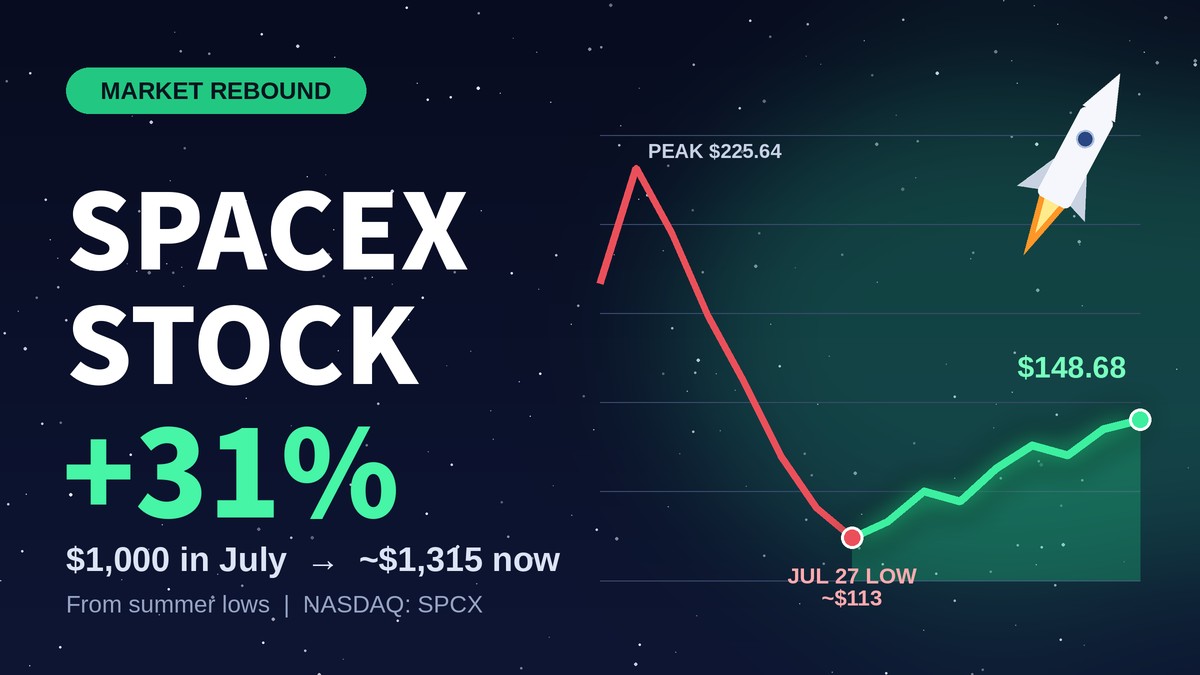
Investors who bought SpaceX stock near its late-July bottom now have solid gains, as shares of the rocket and satellite company have recovered much of a steep post-IPO selloff. The stock (NASDAQ: SPCX) last closed at $148.68, the most recent price cited in the original report, which did not specify the exact closing date.
That price puts shares roughly 31% above the approximately $113 level they traded at on July 27. A $1,000 purchase that day would have bought about 8.85 shares, a position now worth somewhere around $1,310 to $1,316, depending on the exact entry price.
The recovery still leaves ground to make up. Shares remain about 34% below their post-IPO peak of $225.64. Where the stock goes from here will likely depend on Starlink’s subscriber growth, the company’s fast-expanding AI business, and progress on Starship.
What a July Entry Point Looks Like Today
The table below shows how a hypothetical $1,000 investment on July 27 has performed. The figures are approximate because the original report gave only a rounded purchase price.
| Metric | Value |
|---|---|
| Purchase date | July 27, 2026 |
| Approximate share price | $113.00 |
| Shares purchased | About 8.85 |
| Latest closing price | $148.68 |
| Current position value | About $1,310 to $1,316 |
| Approximate gain | About 31% |
How far shares still sit from the peak
The picture looks very different for anyone who bought at the top. At $148.68, the stock trades about a third below its $225.64 post-IPO high. At the July low, shares had lost roughly half their value from that peak. So the current price reflects a partial recovery, not a full one.
Why the Stock Fell After Its Record IPO
SpaceX’s Nasdaq debut in June was one of the largest public offerings on record. The company initially raised about $75 billion. Total proceeds reached $85.7 billion after underwriters exercised their overallotment option, which added roughly $10.7 billion. The offering valued SpaceX at about $1.77 trillion.
The early rally did not last. According to the original report, investors grew wary of three things: the company’s heavy capital spending plans, the cost of its ambitious AI investments, and a series of lockup expirations that added selling pressure.
What a lockup expiration means
After an IPO, company insiders and early investors are usually barred from selling their shares for a set period. When that restriction ends, a large number of shares can become eligible for sale at once. Even if holders don’t sell, the possibility alone can weigh on the price.
The Business Behind the Rebound
AI has become a second engine
SpaceX’s biggest strategic shift in 2026 has been its move into artificial intelligence. Earlier this year, the company absorbed Elon Musk’s xAI, bringing the Grok chatbot, the X social platform, and the Colossus computing infrastructure under one roof.
It went further in August by acquiring Anysphere, the developer of the AI coding assistant Cursor. The report said long-term computing agreements tied to these businesses are expected to generate billions of dollars in recurring revenue.
Starlink is still the core
AI has drawn the headlines, but Starlink remains the company’s main commercial business. The satellite internet service keeps adding customers across consumer, enterprise, aviation, maritime, and government markets. For many investors following SpaceX stock, Starlink’s growth rate is still the number that matters most.
Government contracts add visibility
SpaceX has also deepened its role as a major federal contractor this year:
| Agency | Award | Timing | Scope |
|---|---|---|---|
| U.S. Space Force | $1.6 billion | July 2026 | 18 Falcon 9 launches through 2027 |
| Pentagon (combined) | More than $7 billion | 2026 to date | Multiple awards |
| NASA | Nearly $950 million expansion | September 2026 | Three more Dragon missions to the ISS under Commercial Crew |
These contracts give the company revenue that is less tied to consumer demand. Falcon 9 continues to lead the commercial launch market, while Starship works toward more ambitious orbital missions.
What Investors Will Watch Next
The rebound in SpaceX stock has come as the company’s story broadened beyond rockets. Four factors are likely to shape its next move: whether Starlink keeps adding subscribers at a strong pace, how well the company executes on its AI expansion, whether demand for computing infrastructure holds up, and how quickly Starship advances.
Spending remains the open question. The same AI and infrastructure ambitions fueling investor interest were part of what drove the summer selloff, and the market has not yet shown whether it will reward that spending over time.
Disclaimer: This content was partially produced with the help of AI tools and This content is for informational purposes only and not investment advice.