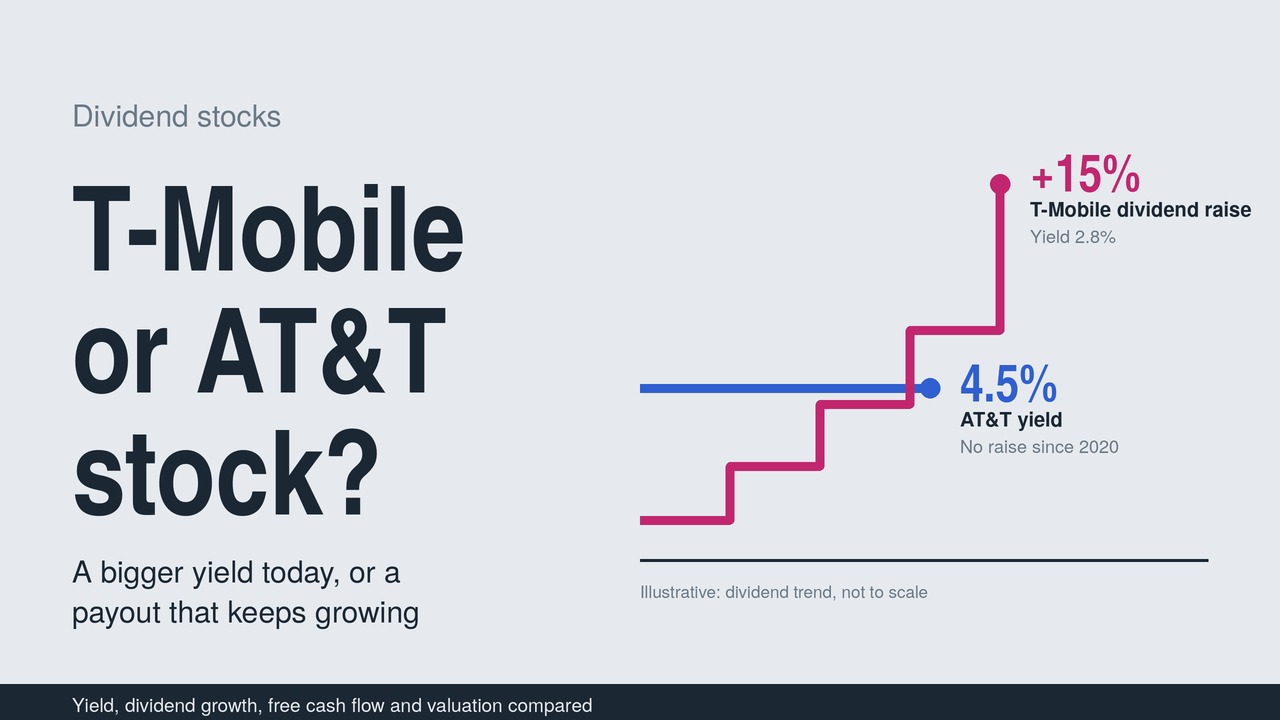
T-Mobile US has announced a 15% increase to its dividend, and the move sharpens a question many income investors in telecom are already asking. AT&T still pays the richer yield. T-Mobile is the one growing its payout, and both stocks trade well below where they stood a year ago.
The numbers frame the choice clearly. AT&T yields about 4.5%, compared with roughly 2.8% for T-Mobile, and both sit far above the S&P 500 average of about 1.1%. Over the past 12 months, AT&T shares have fallen about 12%, while T-Mobile has dropped around 30%.
For anyone deciding between T-Mobile or AT&T stock, the real tradeoff is income today versus income growth over time. Recent quarterly results, cash flow coverage, and valuation show where each company stands heading into the rest of the year.
The Two Carriers Side by Side
| Metric | AT&T | T-Mobile US |
|---|---|---|
| Dividend yield | About 4.5% | About 2.8% |
| Most recent dividend increase | None since 2020 | 15%, announced recently |
| Cash dividends paid (past year) | About $8 billion | About $4.3 billion |
| Q2 revenue | $31.6 billion (up 2.3%) | $22.8 billion (up 7.9%) |
| Q2 free cash flow | $4.7 billion | $4.8 billion (adjusted) |
| Forward P/E | About 10 | Just under 12 |
| One-year share performance | Down about 12% | Down about 30% |
These figures come from the companies’ second-quarter reports released in July and from market data at the time the original analysis was published. Yields and valuation multiples move with share prices, so current numbers may differ.
T-Mobile’s raise is unusually large
Most established dividend payers lift their payouts by low single digits. A 15% jump is a stronger signal, suggesting management is confident about cash generation. T-Mobile only began paying a dividend in late 2023, so its track record is short, but it has moved quickly. If that pace continues, the yield gap with AT&T could narrow over time.
AT&T’s payout has been flat for years
AT&T has not raised its dividend since 2020. The more important backdrop is that in 2022, after spinning off WarnerMedia, the company reset its payout lower, to $0.2775 per share each quarter. That rate has held since, which means AT&T now offers stability and a high yield rather than growth.
Can Both Companies Afford Their Dividends?
AT&T has a comfortable cushion
AT&T’s free cash flow rose to $4.7 billion in the second quarter, up from $4.4 billion a year earlier, on revenue growth of 2.3%. With about $8 billion in annual dividends, the payout works out to roughly $2 billion per quarter. Based on these figures, dividends absorb a bit under half of quarterly free cash flow, a level that supports the view that the current payout is secure.
T-Mobile has room even after the increase
T-Mobile’s revenue climbed 7.9%, the faster pace of the two, although its earnings were roughly unchanged from a year earlier. Adjusted free cash flow grew 4% to $4.8 billion. The company paid about $4.3 billion in dividends over the past four quarters, or around $1.1 billion per quarter. Even after a 15% raise, a rough estimate puts quarterly dividends near a quarter of the latest quarter’s adjusted free cash flow. The exact figure will depend on share count, since buybacks reduce the number of shares receiving payouts.
Why Telecom Shares Have Struggled
Two concerns have weighed on the sector. The first is interest rates. When bond yields rise, dividend stocks face more competition for income-focused money, and their share prices often suffer.
The second is competition from Space Exploration Technologies Corp., better known as SpaceX, whose Starlink network has pushed into mobile connectivity.
Background: SpaceX’s wireless ambitions
In 2025, SpaceX agreed to buy wireless spectrum licenses from EchoStar in a deal valued at about $17 billion, a step toward offering satellite service directly to phones. T-Mobile already works with Starlink on satellite texting for its customers, which leaves it both a partner and a potential competitor.
Valuation: What Investors Pay for Growth
T-Mobile trades at a forward price-to-earnings ratio just under 12, while AT&T sits at about 10. The premium reflects T-Mobile’s faster revenue growth. Its steeper share price decline over the past year also started from a richer valuation, so part of the drop represents a narrowing of that premium.
How the original analysis weighs the choice
The author of the original analysis favors T-Mobile, arguing that its growth justifies the higher multiple and that strong free cash flow gives it capacity to keep raising the dividend. The author also expects it to outperform AT&T from here.
The counterpoint is straightforward. Investors who prioritize maximum current income may prefer AT&T, which offers a yield roughly 1.7 percentage points higher and a cheaper valuation, with well-covered payments. The better pick in the T-Mobile or AT&T stock debate largely depends on whether a portfolio needs cash now or growing cash later.
Disclaimer: This content was partially produced with the help of AI tools and This content is for informational purposes only and not investment advice.