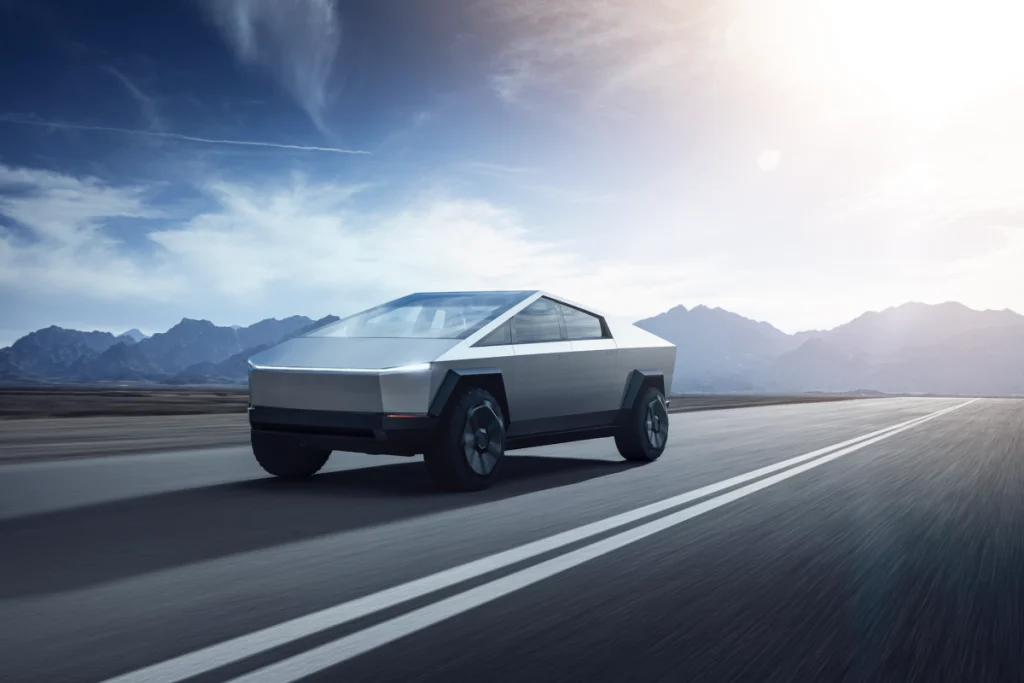
Tesla will stop making the Cybertruck next year, CEO Elon Musk said Friday, closing the book on a pickup that generated enormous attention and a million reservations but never converted that enthusiasm into mass-market sales.
The decision follows a production run that began with first deliveries in November 2023 and has produced an estimated 71,000 vehicles. Industry estimates put the total far below the 1 million reservations Musk said the truck had attracted during Tesla’s third-quarter 2023 earnings call.
The Cybertruck made its public debut at a 2019 Tesla event that became memorable less for its angular, postapocalyptic design than for the crowd’s reaction. Head designer Franz von Holzhausen threw a metal, baseball-sized ball at the driver’s-side window. The result was cracked glass—two windows by the end of the presentation—along with awkward jokes and chuckling from Musk.
Attendees gasped when the truck rolled onto the stage, some in revulsion. Tesla superfans whispered, “This certainly can’t be the Cybertruck?” Others cheered. The momentary shock gave way to support and acceptance, and by the time attendees lined up for Cybertruck rides, the crowd had turned into fans.
That fandom carried into reservations, which Musk said reached 1 million in 2023. It did not carry into actual purchases. The Cybertruck was always going to be a niche product, and its polarizing design may have limited its audience. The practical gaps were more damaging: Musk promised a 500-mile range and a price under $40,000, and the production truck achieved neither. That mismatch gave practical buyers reasons to look elsewhere.
Zipline expands drone delivery with $1.5 billion raise and Walmart deal
Zipline, the autonomous drone delivery startup founded in 2014, has scaled steadily in recent years, and 2026 has accelerated that growth. Early in the year, the company raised $600 million and quickly added another $200 million to its Series H round. It planned to use the funds to accelerate expansion to at least four U.S. cities in 2026.
This week, Zipline said it raised $1.5 billion and expanded its partnership with Walmart to add 300 drone delivery sites across the United States. The company is now valued at $21.5 billion.
Other funding and acquisitions
Electric truck startup Harbinger raised a $240 million Series D round as it expands its product portfolio, including battery storage and defense applications. The company did not disclose its valuation.
Humble Robotics raised $51 million in a Series A round, bringing total funding to $75 million less than a year after it was founded. Obvious Ventures led the round, with participation from insiders Eclipse, Energy Impact Partners and others.
Static Media acquired automotive news site CarScoops, adding to a portfolio that includes 34 brands such as Engadget, Jalopnik and SlashGear.
Micromobility, delivery and automotive
The micromobility startup Also, which was spun out of Rivian in 2025, quietly started and then walked away from an electric two-wheeler pilot project in Kenya earlier this year as it sought to focus resources on its consumer e-bike and autonomous vehicle ambitions.
Amazon has made Uber Eats its official restaurant delivery partner for Prime members in the United States, effectively ending the e-commerce giant’s existing deal with Grubhub.
The Luce, Ferrari’s first electric car and one of its most polarizing models, is “fully allocated” for 2027.
Ford unveiled what it called a “privacy promise”—an “explicit commitment” to keep customers’ vehicle data safe and give them control over what they share. Ford also launched a website designed to educate customers about how, where and why the automaker uses their data, and to show them how to change those settings.
Defense, robotics and autonomous vehicles
May Mobility and Forterra advanced to phase three of the Department of Defense’s Robotic Operations for Autonomous Delivery and Sustainment (ROADS) prize challenge, an initiative to test and adopt commercial self-driving vehicles in the military.
Serve Robotics announced plans to launch a new business line called Physical AI Services. The company will still operate and expand its autonomous delivery operations and become a technology supplier to other companies building robots.
Predictions that AI agents would book restaurants, trips and even rides for the masses have not materialized. Uber reported during its third-quarter earnings call that only four rides were ordered through an AI agent during its busiest week in October: the week of Halloween.
Waymo confirmed it will end its exclusivity with Uber in the Austin and Atlanta markets starting in January 2028, after months of speculation.
Transportation reporter moves to The Wall Street Journal
Senior reporter Sean O’Kane is leaving to cover Tesla for The Wall Street Journal. Over the past three years, his work has included a scoop that Jeff Bezos was backing Slate Auto; a story on how Jony Ive’s LoveFrom worked on the design of the Also e-bike; an investigation into Fisker; and coverage of how Waymo was relying on first responders to help move its robotaxis. He also co-bylined dozens of articles on company earnings and breaking news and co-hosted the Equity podcast.