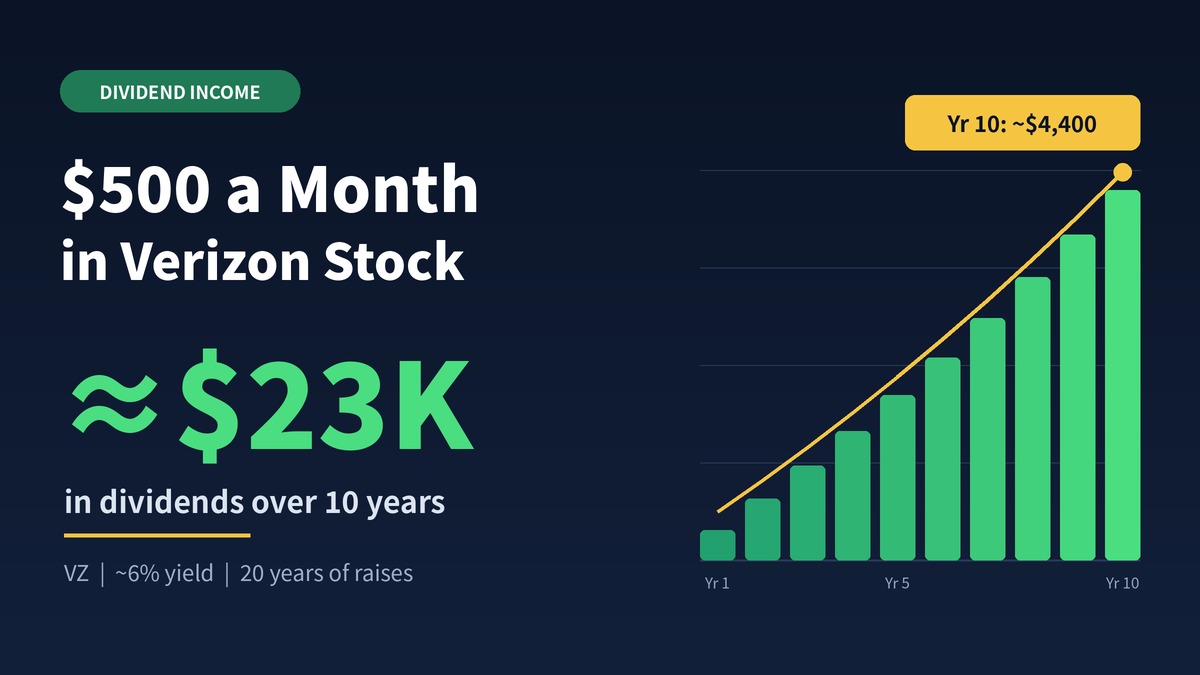
Investing $500 a month in Verizon Communications Stock could produce roughly $22,700 to $23,700 in total dividend income over ten years, based on a recent investor projection and our own recalculation of its math. The question is timely: Verizon’s board declared a quarterly dividend of 70.75 cents per share, payable on November 2, 2026 to shareholders of record at the close of business on October 9, 2026.
The projection starts with a dividend yield of about 6%. At that rate, the first $6,000 invested (twelve monthly purchases of $500) generates $360 in dividends in year one. The payout then compounds two ways: through new money added each year, and through Verizon’s annual dividend raises.
Those two forces explain most of the result, but the headline figure depends heavily on which dividend growth rate you plug in. The original analysis cites one rate and appears to calculate with another, which moves the ten-year total by about $1,000.
How the $500-a-month projection works
The core assumptions
The model assumes you add $6,000 every year, the dividend yield holds steady, and Verizon keeps raising its payout at a consistent pace. By year ten, you would have $60,000 of your own money invested. Dividends are treated as cash collected, not reinvested.
The original analysis states that Verizon’s payout has grown about 2.3% a year over the past decade. However, its year-by-year figures ($742 in year two, $1,146 in year three, $4,697 in year ten) match a 3% growth rate, not 2.3%.
Year-by-year dividend income
| Year | Total invested | Income at 2.3% growth | Income at 3% growth |
|---|---|---|---|
| 1 | $6,000 | $360 | $360 |
| 2 | $12,000 | $737 | $742 |
| 3 | $18,000 | $1,130 | $1,146 |
| 4 | $24,000 | $1,542 | $1,574 |
| 5 | $30,000 | $1,971 | $2,026 |
| 6 | $36,000 | $2,420 | $2,504 |
| 7 | $42,000 | $2,888 | $3,009 |
| 8 | $48,000 | $3,377 | $3,542 |
| 9 | $54,000 | $3,886 | $4,104 |
| 10 | $60,000 | $4,418 | $4,697 |
| Total | $22,729 | $23,703 |
Which rate is more realistic?
Recent history lands between the two. In January 2026, the board raised the dividend by $0.07 per share on an annualized basis, or 2.5%, according to Verizon’s Form 8-K filed with the SEC. If raises stay near that level, the ten-year total would fall closer to the lower column than the headline $23,700.
Where Verizon’s dividend stands today
The current payout
Verizon now pays $0.7075 per share each quarter. At $2.83 per share on an annualized basis, a yield near 6% implies a share price in the high $40s. The company describes its record as twenty consecutive years of dividend increases, though some third-party trackers count the streak differently, so the company’s own figure is the safer reference.
One shift worth noting: the most recent raise was declared on January 30, 2026, the same day as Verizon’s fourth-quarter 2025 earnings call, rather than in September as in the previous five years. Investors expecting a fall increase this year should not read the unchanged September declaration as a pause.
Can cash flow keep supporting it?
Dividend durability depends on free cash flow, and the recent numbers are solid. Verizon generated $10.2 billion in free cash flow during the first half of 2026, up 16% from the same period last year. By one outside calculation, Verizon paid its dividend with a little under 60% of its free cash flow in both full-year 2025 and the first half of 2026, leaving the remainder for other uses such as debt reduction and share repurchases.
Debt is the counterweight. Analysts note that Verizon still carries a meaningful amount of debt, and cash spent on the dividend competes with deleveraging and network investment.
Price growth is a separate question
Dividend income is only part of the return. Verizon shares have averaged just 2% annual gains over the past 15 years without dividend reinvestment, according to the original analysis, though they averaged 13.3% a year over the past three years.
For a sense of scale, the analysis modeled total portfolio value assuming a steady 8% annual return, slightly below the S&P 500’s long-run average near 10%:
| Years at 8% | $6,000 per year | $12,000 per year |
|---|---|---|
| 5 | $35,199 | $70,399 |
| 10 | $86,919 | $173,839 |
| 20 | $274,572 | $549,144 |
| 30 | $679,699 | $1,359,399 |
Given Verizon’s slower long-term price history, 8% is an optimistic stand-in for this particular stock, even if it is conservative for the broad market.
What the projection leaves out
The model ignores taxes on dividends, which reduce take-home income in a regular brokerage account. It also skips reinvestment, which would raise the totals. And it assumes a constant yield, which is unlikely: yield moves inversely with the share price, so buying at higher prices would lower the income each new dollar produces. A dividend cut, while not signaled by the company, would break the model entirely.
Taken together, Verizon Communications Stock can plausibly deliver around $22,000 or more in dividends from $500 monthly contributions over a decade, provided its payout keeps growing modestly and its cash flow holds up.
Disclaimer: This content was partially produced with the help of AI tools and This content is for informational purposes only and not investment advice.