Slovyansk, one of four cities anchoring Ukraine’s “fortress belt” in the eastern Donetsk region, is under near-constant attack from Russian drones, missiles and glide bombs — and its fate has become a central question in peace talks that resumed in Abu Dhabi after a nine-month pause between Ukraine, Russia and the United States.
Russia wants Kyiv to hand over the fortress cities still in Ukrainian hands. Ukrainians fear that giving them up would make it far easier for Russian forces to push further west, including toward the capital, Kyiv. President Volodymyr Zelensky has refused to cede the territory, even as the White House sounds positive about the revived negotiations.
Getting into Slovyansk requires a military escort, and the rules are set before the journey begins. “If I say run, you run,” Tetiana, 21, tells visitors. She and her colleague Yasha belong to a drone unit that calls itself Peaky Blinders, after the television series, and wears camouflage flat caps of the sort the show made famous as its emblem.
Rain and low cloud cover the approach. The escorts call the weather “good” — meaning it is bad for drones. The threat does not disappear. Yasha keeps his eyes fixed on the sky, while Tetiana scans her phone for the latest military intelligence on likely incoming threats from the air. Yasha carries a shotgun, a last resort for bringing down a Russian drone. Tetiana explains, in halting English, that moving on foot is safer than traveling by car.
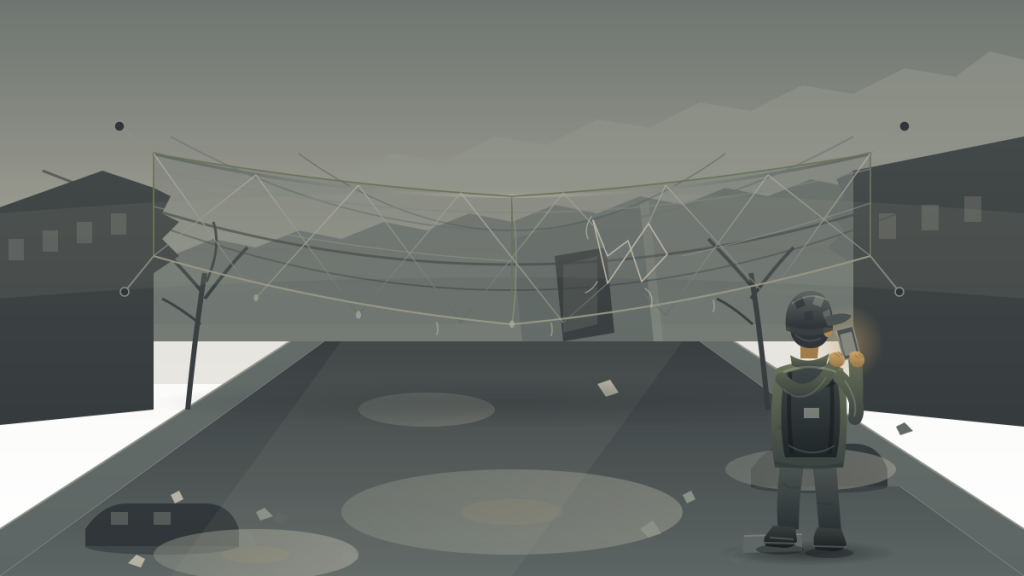
Inside the city, vehicles are parked out of sight under trees and the group continues on foot. Abandoned cars litter the streets, several of them destroyed in recent days by remotely operated Russian first-person-view drones. Anti-drone netting strung over the roads offers no guarantee of safety. Tetiana shows a video recorded on her phone a few days earlier: several drones buzz overhead, then a cacophony of small-arms fire as Ukrainian forces try to shoot them down. She admits the situation can be frightening, and says she felt compelled to help her country, setting aside her dream of becoming an opera singer.
Slovyansk is now a husk of its former self. Very few buildings have escaped damage, and many have been reduced to rubble. Tetiana points out a school recently destroyed by Russian glide bombs. Across the road, an abandoned residential block has a gaping hole in its facade, and broken glass covers the pavement. The handful of shops still operating are boarded up, making it hard to tell which are open; most have closed.
Tetiana says Russian forces are doing everything they can to intimidate people and drive them out. That, in her view, “is their strategy — to make people leave in chaos, gathering up their last belongings and fleeing amid enormous fear and suffering. They want people to have nowhere left to live.”
It is a pattern already seen in other towns and cities of the Donbas, such as Pokrovsk and Bakhmut, which were reduced to rubble and ultimately fell into Russian hands. Russia has already taken nearly 90% of the Donbas — the regions of Luhansk and Donetsk — but its advances this year have all but stalled in the face of strong Ukrainian resistance.
October was the deadliest month for Russian troops since the start of the full-scale invasion, with more than 54,000 killed or injured, according to Ukraine’s General Staff. Even so, Russian forces are making life in the fortress-belt cities almost impossible.
Before the war, Slovyansk was home to more than 200,000 people. Fewer than 10% remain, and the population shrinks by the day. Amid the wail of near-constant air-raid warnings, there are still signs of people clinging to life here.
Iryna works in one of the city’s last remaining coffee shops and was born in Slovyansk. “I’m forced to walk around crying,” she says. “How can they do this?” Life, she says, has become incredibly difficult. She has already lost her house, but her defiance holds: “I won’t leave Slovyansk. This is my home.”
Inga, 53, was also born and raised in the city and keeps working there despite the danger. “It’s stressful. Honestly, I don’t even know what to say,” she says. She stays because of what she calls the “fear of the unknown” — she says she has nowhere to go and no money to leave or support herself afterward. Nor does she consider anywhere else in Ukraine truly safe.
The drone unit was first encountered two years ago, fighting in the Kharkiv region in north-eastern Ukraine. Only four of the original team remain; the others have moved to different units, been wounded or been killed. Among the dead was the brother of the unit’s commander, Oleksandr, who now describes his unit as his family. He jokes that it is just like the Peaky Blinders television show — “but without the crime and the drugs.”
Back at base, the unit shares a meal every evening. Oleksandr reads a prayer of thanks for surviving another day, which he says strengthens their spirits. Classical music plays from a speaker during the meal, helping to drown out the sound of explosions nearby.
“I feel this is the most difficult situation we’ve ever faced,” Oleksandr says, stressing the importance of holding the line. “We must be here to inflict maximum damage on the enemy. We’re fighting here because this is where the most intense phase of the war is taking place. Russia’s claim that they will reach the borders of the Donbas, seize it, and then the war will end is absolutely false.”
The remaining fortress-belt cities give Ukraine a strong defensive line and represent a major obstacle to any Russian advance. The density of drones in the area now makes it nearly impossible for either side to move forward. Peace talks may have resumed, but Oleksandr notes they have produced nothing so far. “I really want this war to end,” he says, “but do I believe these negotiations will succeed? No, I don’t really believe they will.”
The next morning, civilians are also on the move. About a dozen people gather at an evacuation point in the city center to be escorted out, carrying everything they can. They are taken into a bunker for their safety. Outside, another heavy burst of small-arms fire signals that more drones are nearby.
Alina Shyrko, a Slovyansk resident, coordinates the movement of civilians out of the city. She says the situation has deteriorated rapidly over the past few months, and that families with children have already been ordered to leave. “Everyone is thinking about leaving,” she says. “I’m thinking about it too.”
Ukraine still holds Slovyansk. But its lifeblood — its people — is ebbing away.