
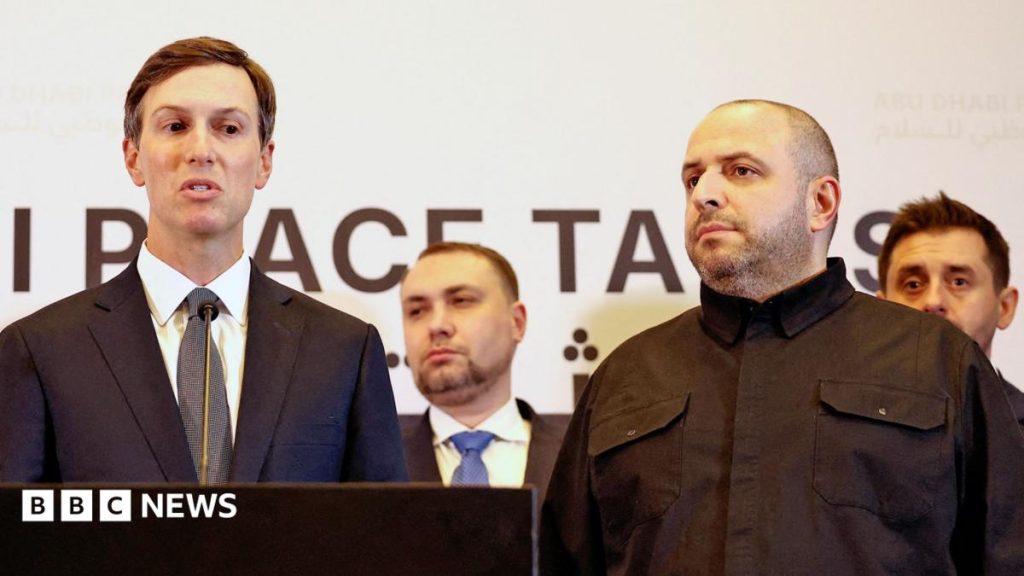
Russia, Ukraine and the United States completed two days of negotiations in Abu Dhabi without announcing a breakthrough toward ending the war. American negotiators said they had identified possible areas for progress, while Moscow and Kyiv confirmed that preparations were under way for a large exchange of prisoners of war.
The meetings were the first such round since February and focused on the arrangements intended to keep Europe secure after the fighting ends. Russia’s invasion has driven a war now approaching its fifth year, and the second day of discussions ended with major disputes still unresolved.
Ukrainian negotiator Davyd Arakhamia described the round as exceptionally difficult. He believed Russia’s delegation had received rigid instructions that left little room to adjust its position, but also said the talks had gained momentum and called for another round as soon as possible.
The next step will be a Thursday trip by US negotiators Steve Witkoff and Jared Kushner, President Donald Trump’s son-in-law, to Moscow for talks with Russian President Vladimir Putin. They are then due to travel to Dublin to meet Ukraine’s Volodymyr Zelensky.
Security guarantees and Europe’s role
For Kyiv, the security discussion may include reassurances that allies will come to Ukraine’s aid if it is attacked again, despite the country not being a NATO member. Moscow is likely to seek limits on NATO’s influence in eastern Europe, a central concern for the Kremlin since the alliance’s eastward expansion.
Kushner said earlier in the week that Washington wanted a framework connecting Ukrainian, Russian and European security that could support a durable peace. Russia’s negotiator Vladimir Medinsky also called for a redesigned security system, describing the existing arrangements as in need of change.
Ukraine and European governments have long been concerned about the current US administration’s commitment to European security and what they see as its softening toward the Kremlin.
Representatives of Britain, NATO and various EU countries were also in Abu Dhabi and met with US and Ukrainian negotiators. The EU does not officially communicate with the Kremlin. The Kremlin said its delegation had not had any contact with the other representatives. Moscow has dismissed European involvement, although European governments have long argued that they are central to any post-war dynamics on the continent. Many people, particularly in eastern Europe, feel their security is linked to Ukraine’s.
A German government spokesperson said on Wednesday that any agreement requiring NATO action would depend on agreement among the alliance’s members. The comment underlined the role European allies expect to have in decisions affecting their own security.
Kushner said the United States wanted European participation and intended to discuss how Europe could join the negotiating format during his meeting with Putin. The issue remains contentious because Russia has resisted a greater European role.
There is also disagreement over sequencing. European governments and Kyiv want discussions on a future security framework to be preceded by a ceasefire, while the Kremlin has insisted that the fighting stop only after an agreement has been reached.
Kushner said a lasting security arrangement would depend on first bringing the war to an end. He added that an end to the fighting would itself require a settlement covering territory and the other disputes between Russia and Ukraine.
Donetsk remains the core obstacle
Since talks began last year, a core obstacle to any settlement has been Ukraine’s eastern region of Donetsk, most of which Russia occupies. Moscow has demanded that Ukraine relinquish the parts of Donetsk it still holds, while Kyiv wants to freeze the contact line to maintain control over those areas.
Kushner identified the territorial dispute as the most difficult issue. Kyrylo Budanov, Zelensky’s chief of staff and a negotiator, did not say whether Moscow continued to demand that Ukraine withdraw from the parts of Donetsk it controls.
Kushner said the negotiations combined complicated practical questions with intense emotions. He pointed to the lack of trust between the two sides after years of war as a fundamental difficulty in trying to reach a settlement.