
Ukraine’s military is again confronting “systematic” restrictions on the military-grade Starlink service known as Starshield, President Volodymyr Zelensky said, warning that the disruption is hampering Kyiv’s ability to intercept Russian jet-powered drones.
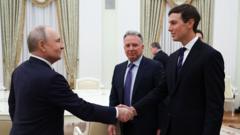
The disclosure came as US envoys Jared Kushner and Steve Witkoff met Russian President Vladimir Putin in Moscow, one day after talks aimed at ending the war in Ukraine concluded in Abu Dhabi.
Speaking to European leaders in Dublin, Zelensky said Ukraine was working with the American side to clarify the Starlink situation. He said “some things” were already clear: “If someone in America is making decisions that basically treat Ukrainian territory as if it is not Ukrainian, then this tells us where things are going.” He did not elaborate.
Starshield was developed by Elon Musk’s SpaceX for government and military use. Together with Starlink, it has become central to communications along Ukraine’s front line. A similar connectivity problem affected the front line in late October, lasting about a week before it was repaired. It remained unclear who ordered the temporary restrictions at that time; US officials and SpaceX offered differing explanations.
Zelensky said the current disruption had lasted several days and was “helping the Russians kill more Ukrainians and carry out more accurate strikes against Ukraine.”
In Moscow, videos distributed by Russian media showed Kushner and Witkoff stepping off a plane and being greeted by Kremlin envoy Kirill Dmitriev with handshakes and embraces. The two later went to the Kremlin, where they met Putin and three of his senior advisers.
Kushner and Witkoff were expected to travel to Dublin to meet Zelensky after the Kremlin talks.
In remarks carried by Russian media, Putin asked the envoys to convey his “gratitude” to US first lady Melania Trump for her role in last month’s ceasefire in the Kherson region, which allowed hundreds of civilians to be evacuated from Oleshky, a Russian-occupied city.
Putin then proposed a similar five-day ceasefire for Kostyantynivka, a contested front-line city in Ukraine’s eastern Donetsk region. Kyiv disputes that Russia fully controls the town, and a truce could help Moscow’s forces mount a final push to seize it.
“Considering that they brought in equipment and rotated troops in Oleshky under the guise of a humanitarian operation, it’s clear what they want in Kostyantynivka,” said Ukrainian presidential adviser Dmitry Lytvyn, adding that the details would need to be “clarified.”
The separate in-person meetings with the Russian and Ukrainian presidents were announced only on Wednesday, after two days of talks described as focused on Europe’s postwar security architecture.
Nearly five years after Russia launched its full-scale invasion of Ukraine, Moscow shows no sign of retreating from its maximalist demands: sovereignty over Ukrainian territory and a Western commitment to abandon any future pledge to defend Kyiv against further attacks. On Thursday, Putin again called the presence of foreign troops in Ukraine “unacceptable” and said Russia wanted the Americans to engage with Europe “so that the Europeans can decide what they truly want: peace or war.”
In the war’s first years, European governments cut off communications with the Kremlin and refused to deal with Russia directly. More recently, many have grown uneasy about the current US administration’s commitment to European security and what they see as its softening stance toward Moscow, and they have pressed for a seat at the negotiating table.
The Abu Dhabi talks were led by the Americans and included only Russia and Ukraine. Kushner said he and Witkoff would ask Putin to “give his blessing” to inviting European representatives to future discussions, particularly on the future configuration of the continent’s security architecture. He also urged Europe to “identify one person to speak on their behalf” in the negotiations.
Russia has opposed the idea, citing Europe’s support for Kyiv as an obstacle. Vladimir Medinsky, who led the Russian delegation in Abu Dhabi, said he believed all parties had “moved closer to achieving peace” but that “a lot depends on Ukraine, on the position of the United States, and on whether Europe comes to its senses.”