
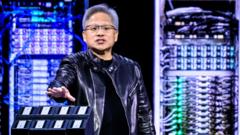
Jensen Huang resigned as chief executive of Nvidia on Thursday, ending a celebrated run at the center of the artificial intelligence boom after back-to-back disclosures about two extramarital affairs. The 63-year-old had been courted by leaders in Washington and Beijing, admired by investors and presented as a loyal family man. His personal reputation went into free fall this week, undone by romantic entanglements that raised doubts about his focus and judgment.
Huang, who favored a black leather jacket and all-black outfits at investor events, had appeared to have it all. He was known as a workaholic and a demanding manager with high standards for those who worked for him, including his own children, who were promoted within the company. His departure creates uncertainty in the global stock market, which had already been knocked off balance in recent weeks.
Nvidia is a linchpin in the US competition with China for technology leadership. The company dominates the market for the microchips that power artificial intelligence, and it is still valued at nearly $4 trillion despite the upheaval. Its customers include Google, Meta, Amazon, Microsoft, SpaceX, Tesla, OpenAI and Anthropic, all spending heavily on its products. Huang may not have the household recognition of Elon Musk or Mark Zuckerberg, but his role in the AI explosion of the past three years may prove more consequential.
A political and corporate power center
Huang enjoyed access to the seats of political power on a scale rarely matched in the corporate world. US President Donald Trump and China’s President Xi Jinping both courted him. At a recent AI summit at the White House, he was picked out from a group of 42 people to flank the president alongside Elon Musk; Trump has famously close relationships with both men. Huang’s rise led to him being dubbed the “Taylor Swift of tech,” and his fortune was estimated at $145 billion, or £109 billion.
Despite the playful approach to investor presentations and the trademark dark clothing, Huang worked for years to present himself as a family man and an example of the American Dream. Born in Taiwan in 1963, he moved with his family to the West Coast of the United States at age nine. He graduated as an electrical engineer from Oregon State University and earned a master’s degree in the same field from Stanford University. He met his wife, Lori Mills, at college, where they were lab partners. They married in 1985, eight years before Huang founded Nvidia, and have two children, Madison and Spencer, who now hold senior roles at their father’s company.
Nvidia became a key provider of computer chips and circuits used for gaming before expanding in a new direction. It now makes the processing chips that power growing AI technology. Huang has described AI as a “new industrial revolution” on par with the arrival of electricity. Nvidia is the world’s second most valuable company, and its customer list spans the biggest firms on the planet, from Google, Meta, Amazon and Microsoft to SpaceX, Tesla, OpenAI and Anthropic.
The first disclosure
The first disclosure came on October 29: Huang had been in a relationship with Alice Huang, who is not related to him. US officials allege that Alice Huang, a businesswoman associated with Singapore-based firm Megaspeed, is a Chinese intelligence asset. The relationship ricocheted around the world and raised eyebrows among investors. After the revelation, Huang admitted he had been “unfaithful” to his wife and apologized for hurting their family. Trump and other leaders in the AI technology industry initially backed Huang to continue in his role. The president described him as “honorable.”
A second affair and a board meeting
A second disclosure, on Wednesday, described an affair with Kimberly Powell, Nvidia’s vice president of healthcare, who has worked at the company for 18 years. That revelation prompted a board meeting, followed by the announcement that Huang was stepping down. In the aftermath, Trump said Huang had done a “fantastic job” and proposed Tim Cook of Apple as a suitable replacement at the head of Nvidia.
Stephen Witt, author of “Thinking Machine,” a biography of Huang, said Huang is a technology visionary in the mold of Steve Jobs and was responsible for creating the AI hardware known today. Witt described him as a demanding boss who “really pushes his people to the limit.” He called Huang “very brilliant” and a “world-class computer scientist,” while also pointing to “a level of arrogance” and “a level of self-deception.”
Witt said Huang had gone to great lengths to present himself as a family man, something that was “very important to him.” “He praises his wife, he talks about her in very glowing ways,” Witt said. “The fallout of this would be bad for anyone’s family. But for someone who has gone to such great lengths to cultivate an image of being a family guy and who keeps his children very close, it is very bad.”
The contrast between that carefully built image and the disclosures has been stark. For years, Huang mixed the persona of a hard-charging engineer with that of a devoted husband and father. His children’s senior roles at Nvidia formed part of the same story, as did his habit of praising his wife in public. The affairs, and the doubt they cast on his judgment, have now overshadowed the corporate milestones that made him one of the most influential executives in technology.