
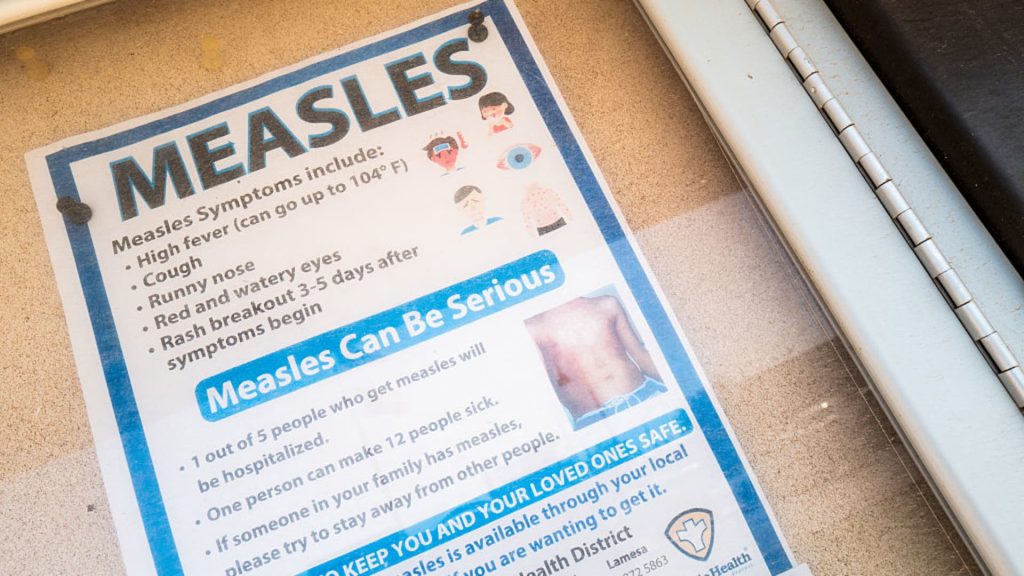
The return of measles in the United States is carrying a steep financial cost alongside its toll on public health. A new Johns Hopkins University tool estimates that outbreaks nationwide in 2026 have generated nearly $83 million in economic costs, as more than 5,100 cases have been reported as of early November — the country’s worst measles outbreak in more than three decades.
The U.S. is expected to lose its official measles elimination status following a review by the Pan American Health Organization this week. States have confirmed eight deaths associated with the disease in 2026: six in Pennsylvania, one in New York and one in Wisconsin.
For 2026, the Johns Hopkins estimate includes $56 million in public health response costs, almost $25 million in lost productivity and more than $1.8 million in direct medical expenses. The same tool puts the economic cost of the 2025 outbreaks, which involved 2,289 confirmed cases, at more than $37 million.
A preventable illness with a costly response
Measles outbreaks can trigger expensive public health action even when many people exposed never become sick. Once a case is identified, health officials must investigate the infection, identify and notify people who may have been exposed, coordinate with hospitals and schools, and sometimes organize vaccination campaigns to stop further spread. The work can pull staff and resources from other public health priorities.
Those costs extend beyond treating infected patients. They include the resources health departments spend investigating and containing outbreaks and the wages lost when people must miss work.
Bryan Patenaude, a health economist who helped build the tool at the International Vaccine Access Center in the Johns Hopkins Bloomberg School of Public Health, said unvaccinated children can reach adulthood without encountering measles because others around them were protected. If that protection weakens, they may face serious illness, costly hospital care or death when they are eventually exposed.
The estimates are not a definitive accounting of what outbreaks actually cost. They do illustrate the bill attached to a disease that vaccination can prevent and the potential economic consequences of declining childhood immunization rates.
The resurgence has also exposed weaknesses in the U.S. public health system and raised concerns about the return of other diseases that had been eliminated.
Costs vary widely by state
The Johns Hopkins tool uses more recent, state-specific cost and financing data than an earlier study by the researchers, which relied on historical outbreak costs. It combines national averages with state inputs such as inpatient hospital costs and wages drawn from government data or health policy sources.
In New York, where the average inpatient hospital stay costs roughly $4,200 a day and the minimum wage is $16 an hour, the 48 cases reported in 2025 carried an estimated $1.1 million in costs. That total includes nearly $749,000 in public health responses, $333,000 in productivity losses and about $24,500 in direct medical expenses.
Texas, the center of the largest U.S. outbreak in 2025, reported 803 cases. The tool estimates those cases cost nearly $13 million, including $9 million in public health costs, $4 million in productivity losses and around $288,000 in direct medical expenses.
Labor drives the up-front bill
The new estimate builds on an August study by Patenaude and other researchers that examined U.S. measles outbreak costs. The researchers reviewed published studies and government reports to compile historical estimates of medical expenses and public health response costs across 18 states. That paper estimated outbreaks carried a historical average cost of nearly $59,000 per case from the public health response alone.
The researchers also modeled how costs scale with outbreak size, separating fixed up-front expenses from the additional costs tied to each new case. The model estimated roughly $298,000 in fixed costs and about $16,300 for each additional case.
Patenaude said much of an outbreak’s response bill arrives at the outset, when health departments mobilize contact-tracing staff and coordinate the agencies and institutions involved. That staffing work creates substantial costs before the eventual number of cases is known, with labor accounting for a large part of the expense.
That model relied on historical data, including a particularly large 2019 outbreak in New York City where contact-tracing labor costs were high. It excluded productivity losses because most historical studies reviewed did not consistently account for them.
Quarantine and lost wages widen the impact
Measles can impose costs far beyond treatment and public health response. People exposed to the virus may need to quarantine even if they never develop symptoms. Parents may miss work to care for sick or exposed children, and workers who contract measles can lose wages during recovery.
A 2025 study by Joey Mattingly, a pharmacist and health economist at the University of Utah, used published epidemiological and cost data to model a hypothetical 1,500-case outbreak. His analysis included direct medical expenses, public health spending and lost productivity, and tested how estimates changed under different assumptions, including hospitalization rates. It estimated the outbreak could cost about $90 million, including roughly $26 million in productivity losses.
Indirect costs can multiply quickly because measles is highly contagious and one infected person can expose dozens of others. Those contacts may need to quarantine or miss work while officials determine whether they are infected, creating costs even when they never become sick.
Mattingly estimated that each quarantined person could account for roughly $300 in lost productivity alone. If one measles case exposes 40 to 50 people who then need to quarantine, that could translate into an estimated $12,000 to $15,000 in lost productivity, even if none of those contacts become infected.
Mattingly said exposure alone can create a financial burden through time spent in quarantine. As a case generates more contacts who must stay away from work, the total economic effect can multiply even when those contacts do not themselves fall ill.
Local health departments absorb the shock
Mattingly argues the economic costs of outbreaks can quickly outweigh the investment needed to vaccinate people against measles. The financial burden can also fall unevenly across communities. Costs may be shared among local, state and federal agencies, but Mattingly said local health departments often feel the impact directly.
Mattingly emphasized that local health departments already have ongoing work when an outbreak begins. Reassigning their teams to a large measles response interrupts those existing responsibilities, so the impact extends to the other services and priorities that staff would otherwise be handling.
Patenaude said the findings could help state and local health departments better anticipate the resources needed to contain outbreaks, particularly as cases continue to rise.
Patenaude said treating a single measles patient can cost much less than treating a single cancer patient. The larger problem, he said, is repeated outbreaks: state and local departments must repeatedly move resources away from other work, allowing the cumulative bill to grow quickly.