
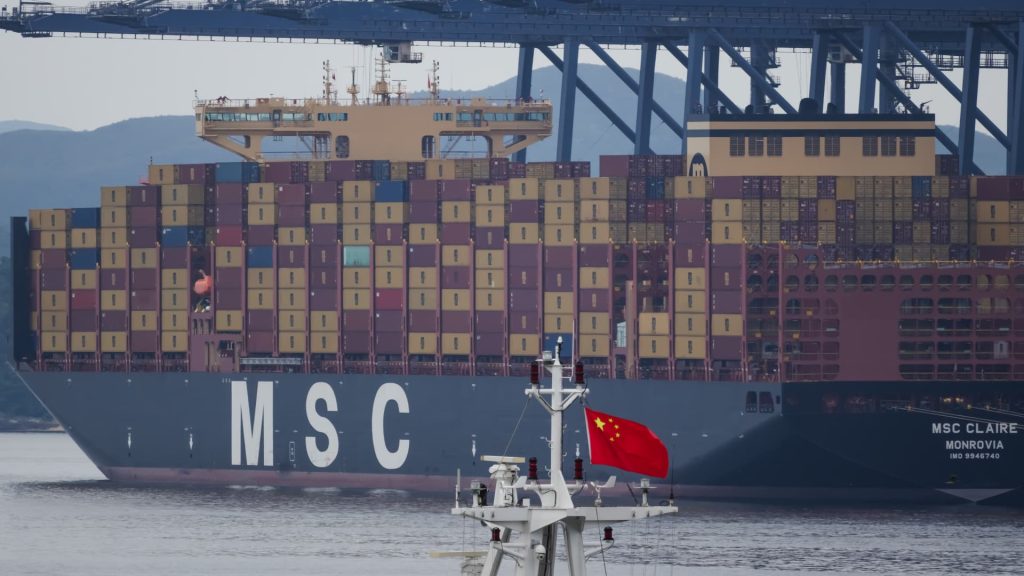
China’s goods trade surplus exceeded $1 trillion in the first ten months of 2026, reaching the threshold faster than in any previous year, as exports of AI-related hardware and other manufactured goods continued to outrun imports and trading partners intensified calls for Beijing to rebalance its economy.
Customs data released on Tuesday put the January-October surplus at $1.04 trillion. That compares with a record $1.2 trillion for the full year 2025, when China’s surplus crossed $1 trillion for the first time. This year’s milestone was reached with two months to spare.
The figure has landed as partner countries raise concerns that Chinese exports are undercutting local industries, and as the International Monetary Fund repeatedly urges Beijing to speed up a shift away from export-led growth toward a model powered by domestic consumption. Within China, household demand remains soft: retail sales rose just 1.1% in September, underscoring the imbalance in the world’s second-largest economy. Strong export receipts have nonetheless allowed policymakers to keep relying on moderate support measures in pursuit of the country’s annual growth target of 4.5% to 5%.
October exports beat forecasts
Exports rose 35.2% in October from a year earlier, above the 33.5% increase economists polled by Reuters had expected, though slightly below September’s 36.3% pace. Imports climbed 41.6%, the strongest since May 2021 and well ahead of forecasts for a 32% rise. Because imports grew faster than exports, the surplus expanded at its slowest pace in six months and came in below market estimates.
Lynn Song, ING Bank’s chief economist for Greater China, said the surplus was still on course for a new full-year record despite falling short of expectations in October.
AI trade and energy dominate imports
Much of the surplus reflects global demand for Chinese-made AI hardware, which has supported growth while households remain reluctant to spend. Tianchen Xu, a senior economist at the Economist Intelligence Unit, said import growth was concentrated in technology goods, critical minerals such as copper, and energy supplies including LNG, oil and coal. He identified AI-related trade as the dominant driver.
High-tech product imports jumped 72% by value in October from a year earlier, based on the customs figures. By value, crude oil imports rose about 41%, LNG about 50% and coal about 60%.
Headwinds build for next year
The heavy reliance on AI-related exports leaves momentum and exporters’ margins exposed to any slowdown in the global infrastructure buildout. Nguyen Hoang Nam, a China economist at Capital Economics, saw signs of softer momentum and estimated that seasonally adjusted exports fell 2% month on month.
Yuanliu Hu, an analyst at Citi Research, expects export growth to slow to 8% in 2027 as favorable base effects fade and global AI investment moderates. Hu identified EU trade friction and the January expiry of the U.S. truce as further uncertainties, considered additional EU measures plausible, and said the approaching leaders’ meeting would test relations with Washington.
Presidents Xi Jinping and Donald Trump are set to meet for a third time this year at the APEC leaders’ summit in Shenzhen next week.
U.S. and EU surpluses widen
China’s exports to the United States jumped 32.9% by value from a year earlier in October, while imports from the U.S. grew nearly 35%, leaving a bilateral surplus of $32.7 billion. U.S.-bound shipments were up 12.1% in the year through October, helped partly by a low base: shipments plunged 20% last year after steep tariff increases.
Washington and Beijing agreed in September to extend a broader trade truce by two months, to January, alongside a series of other measures, including export-control waivers for certain critical minerals and special port fees on each other’s vessels.
The EU reached an agreement with Beijing last month to limit imports of Chinese hybrid vehicles over the next few years as part of efforts to reduce its trade deficit with China. In October, China’s shipments to the bloc rose 24.4% while imports from Europe fell more than 4%, widening the surplus to $33.4 billion.
The auto curbs take effect on Dec. 1, and analysts expect them to do little to contain China’s export boom. The cap of 350,000 imported cars a year is above the 300,000 hybrids China exported to Europe last year, but below the 800,000-unit annualized pace of the past three months, according to Brad Setser, a senior fellow at the Council on Foreign Relations and a former U.S. Treasury official who specializes in global trade and capital flows.
Setser said Europe still lacked a coherent approach to trade and industrial policy for cars, as well as a broader economic strategy for its trade relationship with China.