
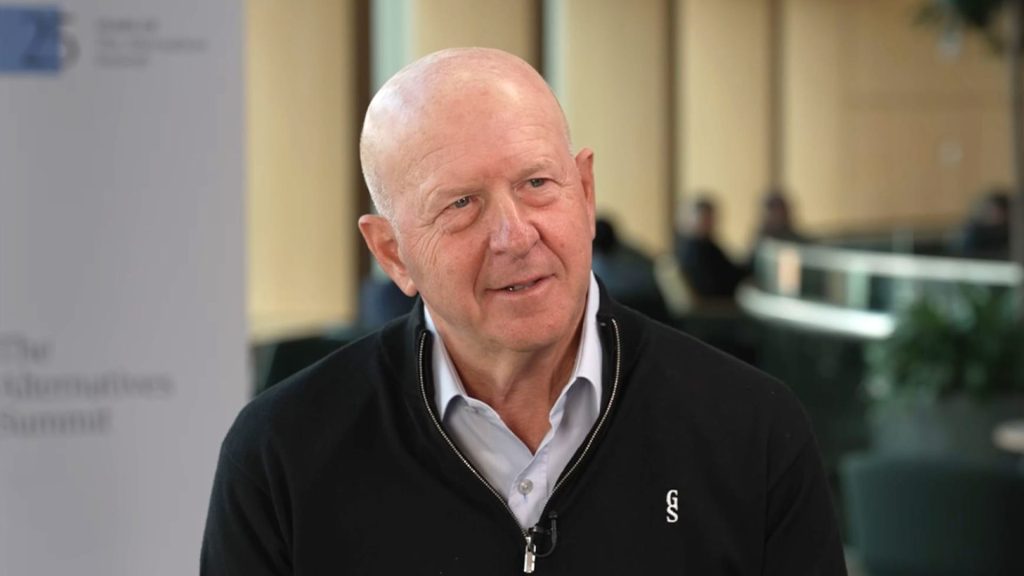
Goldman Sachs CEO David Solomon said on Monday, Nov. 9, that financing demand for artificial intelligence infrastructure remains strong despite recent market jitters, as investors reassess the risks involved in the sector’s massive build-out. He expects capital markets activity to continue over the next two months.
Solomon said Goldman has been “very active” in the markets in recent weeks, including in AI capital markets deals, even as investors recalibrate around AI spending and returns. He expects that activity to continue.
Solomon said investors continued to show strong demand for both AI infrastructure and the technology supporting its expansion.
He said political changes would cause investors to reassess their positions and produce market volatility, some of which was already apparent. He nevertheless remained confident in AI’s long-term ability to improve economic productivity.
Market volatility tests AI financing
AI-related stocks, including chipmakers and neocloud providers, have tumbled in recent weeks as investors reassess whether the hundreds of billions of dollars being poured into AI infrastructure will generate good returns.
The selloff began before the U.S. midterm elections and intensified after Democrats scored sweeping victories in the midterms on the Tuesday before his remarks, raising concerns that political opposition could slow the industry’s expansion.
The shift in sentiment comes at a key moment for AI model lab Anthropic, which is preparing for a potential IPO that could become one of the biggest tests yet of public-market appetite for AI companies. Goldman is among the banks leading the IPO process.
Solomon declined to discuss the prospective IPO in detail, saying its outcome remained to be seen. He described the wider market environment as still supportive.
Resistance to data center construction
Solomon also pushed back against political resistance to data center construction, arguing that the infrastructure is essential to the U.S. economy and can be built responsibly.
He warned that the infrastructure could shift outside the United States if domestic resistance prevented projects from meeting the demand for computing capacity.