
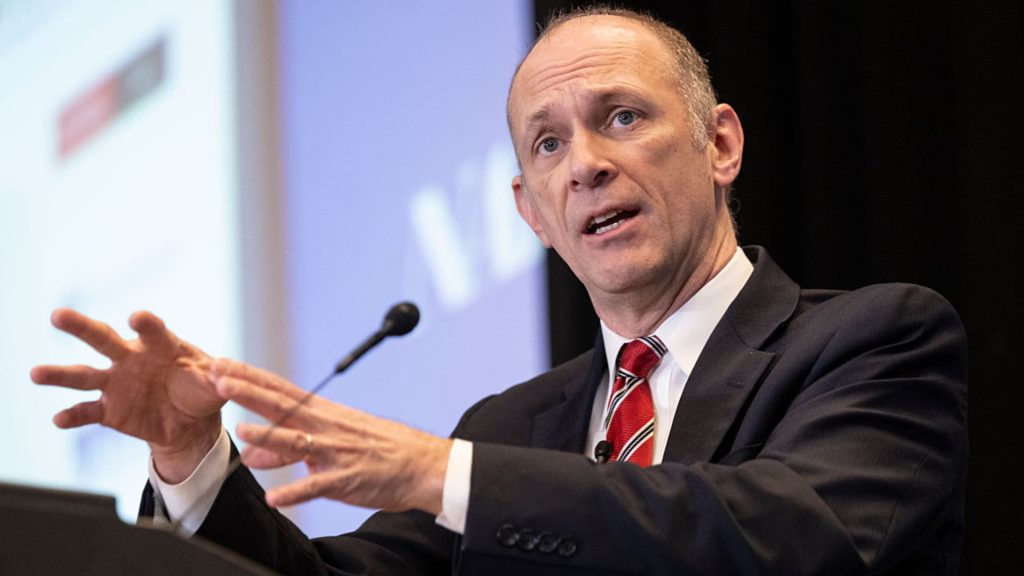
Chicago Federal Reserve President Austan Goolsbee called the October consumer inflation report “borderline disturbing” and “distressing” on Tuesday, saying the central bank has a real and developing inflation problem to address after prices rose faster than forecast for a third straight month.
Goolsbee described an inflation problem that had been building over time and now required a response from the central bank. The latest reading reinforced his concern about the persistence of price pressures rather than providing the easing he had hoped to see.
The consumer price index climbed 0.4% on a seasonally adjusted basis in October, the Bureau of Labor Statistics reported Tuesday. The increase exceeded economists’ predictions and marked another month of outsize price gains.
Goolsbee said he had not seen drivers of prices such as tariffs fade over time as he had hoped. He also flagged persistently high inflation in services as a concern, and said rising prices are a leading issue for the people he meets. “It’s on everyone’s mind,” he said, adding that it is on the minds of businesses, nonprofits and ordinary consumers.
The report arrived at a critical point for the Fed as officials weigh their next rate move and the steps they may need to take in the months ahead if inflation readings remain hot.
Officials weigh the size of the next increase
Other Fed officials also spoke Tuesday. Fed Governor Christopher Waller said in London that a hot inflation report could push him toward advocating a half-point increase in December, rather than the central bank’s usual quarter-point move. Waller said such an outsized hike should be on the table if core CPI, which strips out volatile food and energy costs, was “around 0.3.” Hours later, the core reading came in around that level.
Dallas Fed President Lorie Logan said after the report that she sees a need for two additional quarter-point increases. She also raised the possibility of moving faster this winter than the FOMC had so far this fall.
Philadelphia Fed President Anna Paulson took a more measured view. She acknowledged continuing inflation pressure but favored further gradual tightening. She said the precise rate path would depend on economic conditions and incoming data.
Inflation expectations and market pricing
The Federal Open Market Committee raised rates by a quarter point in September to a range of 3.75%-4%, then voted to hold them steady in October. The Fed typically changes rates in quarter-point increments.
Goolsbee said that after years of price growth above the Fed’s preferred level, the possibility that consumers and businesses begin to expect persistently hot inflation is a “major concern.” If that happens, he said, bringing inflation down could become “much more painful.”
Goolsbee declined to say whether he would favor a rate increase at the December meeting. He said he did not want to commit in advance to a particular decision at the next meeting or at later ones.
Waller, Logan and Paulson are voting members of the FOMC this year, giving them votes on whether to raise rates at the committee’s final meeting of the year in December. Goolsbee will be a voting member next year.
After the inflation report and the officials’ comments, fed funds futures fully priced in a rate hike at the December meeting, according to CME’s FedWatch tool. The open question is whether the Fed will raise rates by a quarter point or a half point. Futures put the odds of a half-point increase at the December meeting at 15%.
The odds of rates reaching 4.25%-4.5% by the January meeting — the equivalent of either one half-point increase or two quarter-point hikes — stood at 60%, with a 10% chance of rates hitting 4.5%-4.75% by then.